How to Extend the Life of a Commercial Roof in Southern California
By Method Roofing Group | July 2026 | 8 min read
Key Takeaways
- Most commercial roofs are replaced early — often years before the membrane is actually done, because owners are offered a replacement quote instead of a life-extension plan.
- The sequence that defers capital expense is maintenance → targeted repair → restoration — each step is cheaper per year of service than the one after it, and each has a point where it stops making sense.
- Restoration can add 10–20 years at roughly one-third of replacement cost on a structurally sound TPO, PVC, EPDM, modified bitumen, metal, or built-up roof — with NDL warranties available to 20 years on qualifying systems.
- Documentation is what keeps manufacturer warranties alive — most commercial warranties require proof of routine inspection and maintenance, and undocumented roofs lose coverage exactly when they need it.
- California’s 50% rule changes the math — replacing more than 50% of the roof area within 12 months triggers full current-code compliance, including Title 24 cool-roof requirements.
- Timing matters this year — with an El Niño winter in the 2026–27 outlook, life-extension work scheduled now costs maintenance prices; the same work in January competes with storm emergencies.
Southern California is one of the best places in the country to own a commercial roof. There’s no hail belt, no freeze-thaw cycling, no snow load. Roofs here die of four things: UV exposure, thermal movement, ponding water, and neglect. You can manage three of them. That’s why the gap between a 20-year roof and a 35-year roof in this region is rarely the material. It’s the management.
Here is the sequence we walk asset managers through. It covers what each stage costs relative to replacement — and the honest signals that a roof is past saving.
What Actually Ages a Commercial Roof in Southern California?
The National Oceanic and Atmospheric Administration’s June 2026 ENSO update confirmed that El Niño conditions are strengthening Four forces do most of the damage. UV radiation breaks down membrane plasticizers and coatings. Southern California roofs take more annual UV than almost any commercial market in the country. Thermal cycling works seams, flashings, and fasteners loose. A roof here can swing 70 degrees between a summer afternoon and a clear night, and it repeats that cycle thousands of times a decade. Ponding water concentrates weight and speeds up chemical breakdown wherever drainage fails. The industry’s working threshold is any water still standing 48 hours after rain. And deferred maintenance converts all of the above from line items into leaks.
Notice what’s missing: catastrophic weather. In this market, roofs rarely fail from a single event. They fail from slow, unaddressed wear. That’s exactly what makes life extension work here.
What Is the Cheapest Way to Extend Commercial Roof Life?
A maintenance program — by a wide margin. That means semi-annual inspections in spring and fall, plus checks after major wind events. It means clear drains and scuppers, tight seams, and small repairs completed while they’re small. For most buildings, this costs a fraction of one percent of replacement value per year. It is the highest-ROI spend in roofing.
It also protects something owners forget they own: the manufacturer warranty. Most commercial membrane warranties require documented periodic inspection and maintenance. A claim on an undocumented roof is an argument; a claim backed by an inspection file is a transaction. Our commercial roof inspection guide covers what a proper inspection includes, and the 12-point checklist shows what to verify before the inspector arrives.
When Does Targeted Repair Still Make Sense?
When damage is localized and the field of the roof is sound. Reworking flashings and penetrations, repairing seams, addressing isolated ponding, replacing saturated insulation in contained areas — these keep a healthy roof on its original service curve. Repair stops making sense when you’re chasing leaks across the roof instead of fixing them in one place. Recurring, migrating leaks point to the membrane, not the flashing.
The full decision framework — including the five factors that separate repair candidates from restoration and replacement candidates — is in our repair, restore, or replace guide.
How Does Roof Restoration Add 10–20 Years?
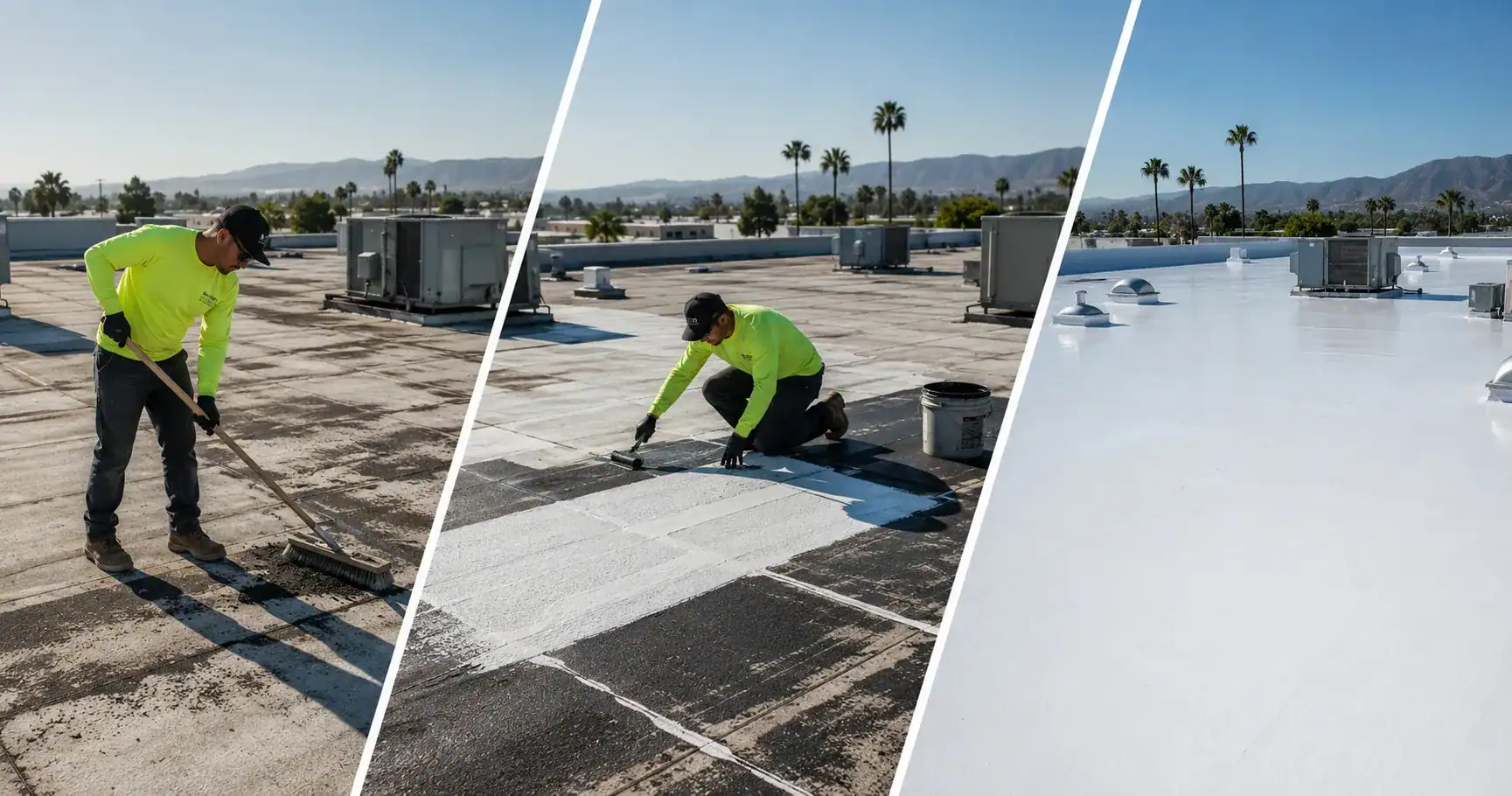
Restoration is the stage most owners never hear about. On a structurally sound roof — TPO, PVC, EPDM, modified bitumen, metal, or built-up — crews clean and repair the existing membrane, then coat it with a fluid-applied system (typically silicone or acrylic). That coating becomes the new weathering surface.
The economics are the argument. Restoration typically runs about one-third of replacement cost and adds 10–20 years of service life. Manufacturer NDL warranties reach 20 years on qualifying systems. There’s no tear-off, so the building stays occupied and operations keep running. Restoration also usually counts as maintenance rather than capital improvement, which can carry tax timing advantages — confirm specifics with your tax advisor.
Run the cost-per-year math and the picture is stark. Restoration costs one-third as much and delivers half to two-thirds of a replacement’s service life. On cost per year, it wins almost every time the roof qualifies. The qualifier is the substrate. Saturated insulation, widespread membrane failure, or structural issues take restoration off the table — a coating over a failed roof is an expensive way to hide a problem for one winter. Full substrate eligibility details are on our commercial roof restoration page.
The Life-Extension Sequence at a Glance
| Stage | When it applies | Typical cost vs. replacement | What it buys |
|---|---|---|---|
| Maintenance program | Every roof, every year | A fraction of 1% per year | Original service life delivered in full; warranty kept alive |
| Targeted repair | Localized damage, sound field | Single-digit % | Roof stays on its original curve |
| Restoration (coating system) | Sound substrate, aging surface | ~One-third | 10–20 additional years; NDL warranties to 20 years |
| Replacement | Saturated insulation, widespread failure | 100% | New service life; full current-code compliance required |
When Should You Stop Extending and Replace?
Three honest signals. First, moisture in the system. Widespread saturated insulation means the roof holds water you can’t coat over. Confirm it with a moisture survey, not guesswork. Second, membrane-level failure. When seams, laps, and field splits open across the whole roof rather than in isolated areas, the membrane is done as a substrate. Third, the 50% threshold. Replace more than 50% of the roof area within 12 months and California requires the entire roof to meet current code — including Title 24 requirements. If repairs are approaching that line, plan a full replacement deliberately instead of tripping the threshold mid-project.
For what replacement actually costs in this market, see our 2026 commercial replacement cost breakdown.
⛈ The 2026–27 timing note (time-sensitive callout — style as box) NOAA’s outlook points to an El Niño winter for 2026–27. Restoration and repair scheduled in summer and early fall are planned work at planned prices; the same scope in December competes with active-leak emergencies across every contractor’s calendar. If a roof in your portfolio is a restoration candidate, this is the season to confirm it. Preparation specifics: El Niño 2026–27 roof preparation guide.
Prefer this on one page? Download Method Memo No. 01 — Flat Roofs: Repair, Restore, or Replace? — the decision table, cost-per-year math, and the five deciding factors on a single printable sheet. Download the one-sheet (PDF). More one-page tools in the Method Memo Library.
Frequently Asked Questions
How long should a commercial roof last in Southern California?
Depends on the system: TPO and PVC commonly deliver 20–30 years, EPDM 20–30, modified bitumen 15–25, and built-up roofing 20–30 — with maintenance being the largest variable inside each range. A maintained roof routinely reaches the top of its range; a neglected one rarely does. System-by-system detail is in our commercial roof lifespan guide.
Is roof restoration worth it on a commercial building?
When the substrate qualifies, restoration is usually the strongest cost-per-year option in commercial roofing: roughly one-third of replacement cost for 10–20 additional years, no tear-off, no operational disruption, and NDL warranties available to 20 years. It is not worth it over saturated insulation or a failing membrane — eligibility starts with a moisture survey.
How often should a commercial roof be inspected?
Twice a year — spring and fall — plus after significant wind or storm events. Most manufacturer warranties require documented periodic inspection; the documentation matters as much as the inspection.
Can you coat over an old commercial roof instead of replacing it?
Only if the roof underneath is structurally sound and dry. A coating is a weathering surface, not a repair — applied over a qualifying substrate it adds a decade or two of life; applied over moisture or membrane failure it hides the problem while it compounds.
What triggers full code compliance on a commercial re-roof in California?
Replacing more than 50% of the roof area within 12 months. Cross that line and the entire roof must meet current code, including Title 24 cool-roof requirements — a planning consideration on any large repair scope.
Does restoration affect my manufacturer warranty?
A restoration system comes with its own manufacturer warranty — NDL coverage to 20 years on qualifying systems — which typically replaces the aging original coverage. What kills warranties isn’t restoration; it’s undocumented maintenance.
About This Article
This article was written by the Method Roofing Group team, drawing on founder Jeff Moreno’s combined manufacturer and contractor operations experience across the industry’s largest commercial and residential roofing names. Method Roofing Group provides documented commercial, residential, and industrial roofing services across Southern California — including commercial roof maintenance programs, targeted repair, fluid-applied restoration systems, and full replacement. Learn more about Method Roofing Group.
Cost relationships cited (such as restoration at roughly one-third of replacement) reflect typical 2026 Southern California commercial pricing and vary by system, condition, access, and scope. Verify with a project-specific assessment. Method Roofing Group operates under CSLB License #1157257.
Get a Life-Extension Read on Your Roof
Before you budget a replacement, find out what your roof actually needs. A Method assessment tells you where the roof is on its service curve, whether it’s a maintenance, repair, or restoration candidate, and what each path costs per year of service — in writing.
Every inspection includes ground-level and drone-supported evaluation, full photo documentation, an annotated roof plan, condition scoring per component, and a written advisory report delivered within 24-48 hours — designed to support insurance claims, HOA submissions, and homeowner decision-making before El Niño 2026-27 storms arrive.
Or call (949) 866-3011 · Serving Orange County, Los Angeles, the Inland Empire, San Diego, and Ventura

