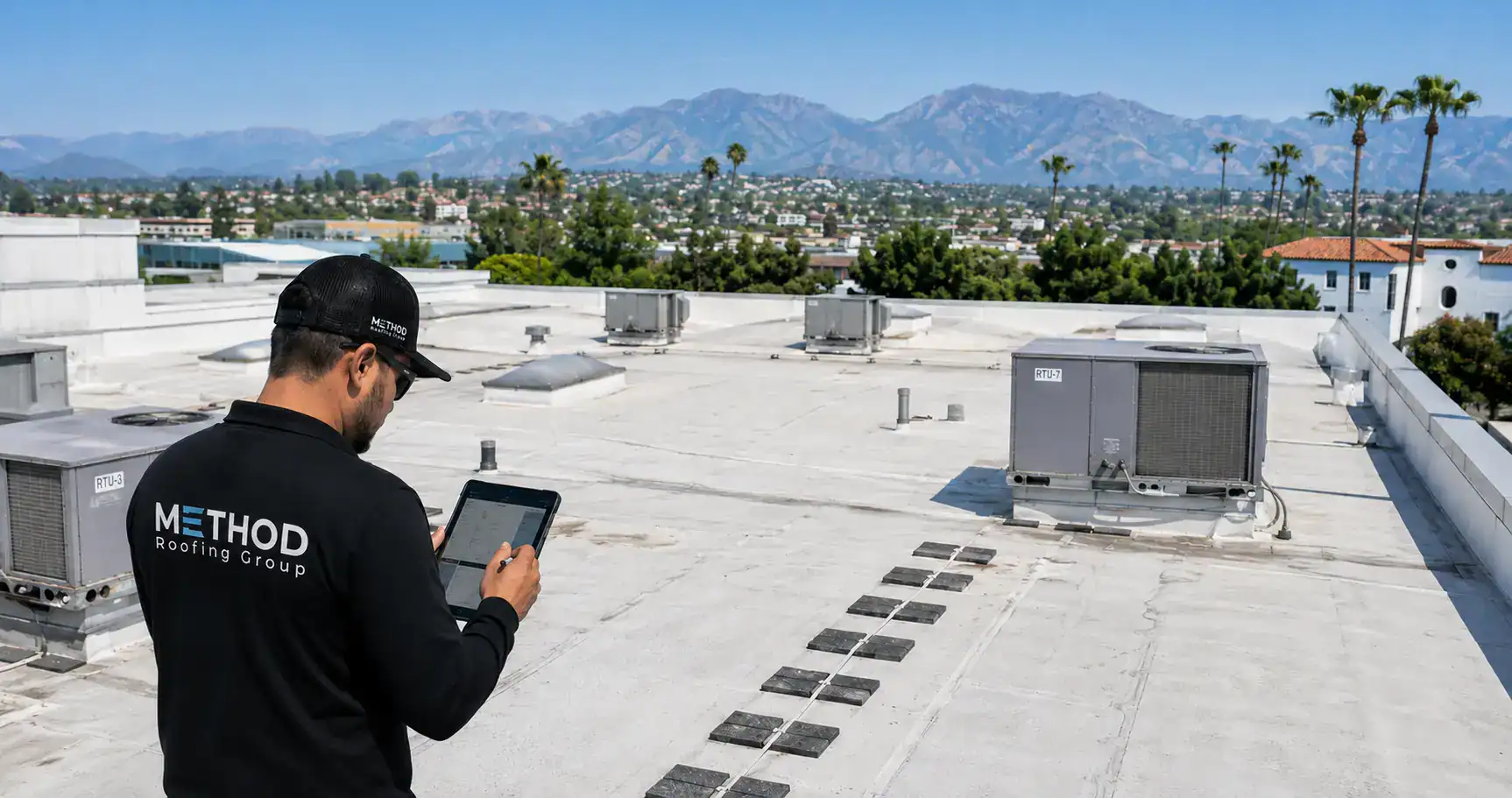
The Commercial Roof Inspection Checklist Every Southern California Property Manager Needs
By Method Roofing Group | June 2026 | 8 min read
Key Takeaways
- A complete commercial roof inspection covers 12 specific points across membrane, drainage, penetrations, perimeter, and structural elements.
- Most California commercial properties should be inspected twice a year, plus after any major storm event.
- Documentation is the inspection. Photos, measurements, and condition ratings are what protect your warranty, your budget, and your liability position.
- Visual in-house checks are useful for early detection. Professional inspections are required for warranty compliance, restoration decisions, and capital planning.
- Verify the contractor’s CSLB license, manufacturer certifications, and insurance before scheduling.
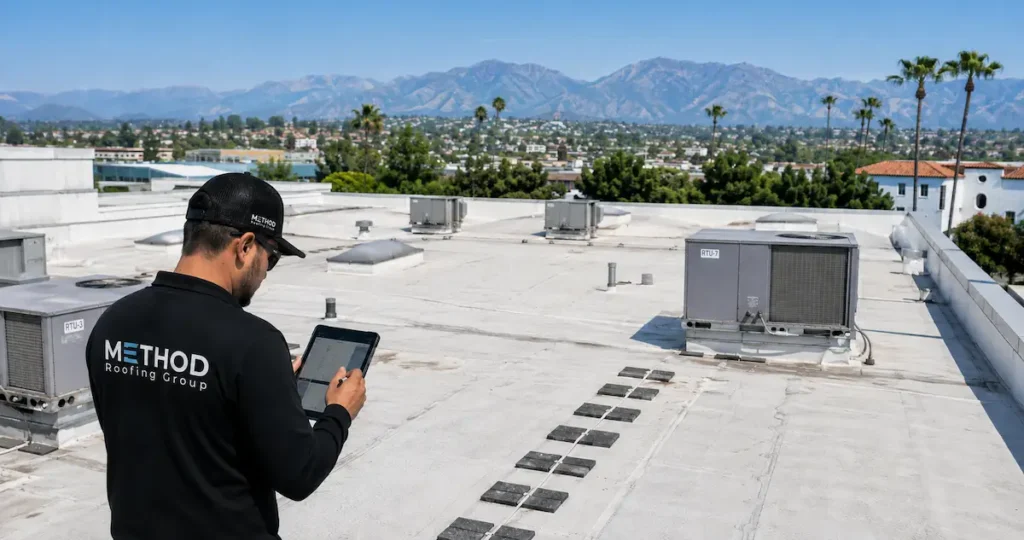
Southern California’s climate is deceptively hard on commercial roofs. Coastal salt air, inland UV exposure, Santa Ana wind events, atmospheric river storms, and California Title 24 compliance pressure all stack on top of normal aging. As a property manager, you don’t need to become a roofing expert. However, you do need to know what a real commercial roof inspection covers — and what should land in your documentation file afterward.
This checklist gives you the 12 inspection points that should appear on every commercial roof report in Southern California, plus the pre-inspection prep, storm triggers, and credential checks that separate a documented inspection from a surface-level walkthrough.
Why Documented Commercial Roof Inspections Matter for Property Managers
Ultimately, a documented commercial roof inspection is the foundation of every defensible capital decision you make about a property’s roofing system. Without it, you’re operating on guesswork — and so is everyone above you.
Three operational realities make documentation non-negotiable in Southern California:
Warranty protection. Manufacturers like Johns Manville, GAF, Sika, and Carlisle require documented annual or semi-annual inspections to maintain warranty validity. Skip them, and a $200,000 manufacturer warranty becomes a $0 manufacturer warranty when you need to file a claim.
Insurance claims. When a Santa Ana wind event or atmospheric river causes damage, insurance carriers require pre-event condition documentation to approve full claims. Without baseline reports, adjusters discount payouts citing “pre-existing condition.”
Capital planning. Asset managers, owners, and boards expect roof condition data tied to repair-vs-restoration-vs-replace decisions. A documented inspection gives you the data. A surface walkthrough gives you a phone call about a leak six months later.
In short, the inspection isn’t the photos or the climb — it’s the report that comes out of it.
The 12-Point Commercial Roof Inspection ChecklistWhy ponding water matters for your warranty
Every commercial roof inspection across Southern California should cover these 12 points. If any are missing from your contractor’s report, request them or escalate.
1. Membrane Condition Assessment
First, inspectors should document the entire membrane surface for cracking, splitting, blistering, alligatoring, granule loss (on cap sheets), UV degradation, and seam integrity. In addition, each finding should include a photograph, a location reference, and a severity rating.
2. Ponding Water and Drainage Performance
Next, standing water 48 hours after rainfall indicates drainage failure or structural deflection. Specifically, inspectors should map every ponding location, measure depth, and note whether the source is slope deficiency, clogged drains, or structural sag.
3. Roof Drain, Scupper, and Downspout Inspection
Additionally, all drains, scuppers, and overflow scuppers must be cleared and tested. Inspectors should photograph each drain, verify clamping ring integrity, check strainer baskets, and confirm overflow scuppers are unobstructed. Notably, clogged drains cause more interior damage in California than any other single roofing failure.
4. Flashing Inspection at All Penetrations
Furthermore, every penetration — HVAC curbs, vent pipes, conduit, skylights, hatches, drains — needs flashing inspected for separation, sealant cracking, fastener backout, and counter flashing integrity. In fact, this is the single highest-failure category on commercial roofs.
5. Perimeter and Edge Metal Inspection
Coping caps, gravel stops, edge metal, gutter systems, and parapet wall conditions must be documented. For example, wind events drive uplift at perimeters first. Loose or oxidized edge metal is the most common Santa Ana–related failure.
6. Penetration Curb and Equipment Condition
HVAC units, exhaust fans, satellite mounts, and solar equipment all sit on penetration curbs. Inspectors should verify curb integrity, equipment anchor points, and the condition of the membrane around each unit. Vibration and rooftop foot traffic accelerate failure here.
7. Skylight and Hatch Inspection
Notably, skylights and roof hatches require glazing inspection, gasket condition checks, frame flashing review, and operability testing. Many California buildings have aging acrylic domes that develop micro-cracking from UV exposure.
8. Coating System Condition (If Applicable)
Similarly, if the roof carries a silicone, acrylic, or SPF coating system, inspectors should document mil thickness verification, chalk and erosion levels, ponding-area performance, and recoat timing. Coatings typically need recoating every 10–15 years depending on system and exposure.
9. Interior Ceiling and Deck Inspection
Importantly, a complete inspection extends below the roof. Inspectors should examine interior ceiling tiles, deck stains, and roof deck condition from below where accessible. Many active leaks present interior signs before exterior signs become visible.
10. Insulation and Substrate Assessment
Where saturation is suspected, inspectors should perform infrared moisture scans or core cuts to evaluate insulation condition. Saturated insulation reduces R-value, accelerates membrane failure, and changes the cost calculation between restoration and full replacement.
11. Walkway Pad and Traffic Pattern Review
Service-traffic patterns to HVAC units accelerate membrane wear. Inspectors should verify walkway pad placement, condition, and adequacy. Missing or worn walkways are a common source of avoidable membrane damage.
12. Code and Warranty Compliance Verification
Finally, the inspector should verify the roof complies with current California Title 24 cool roof requirements (where applicable), Chapter 7A Wildland-Urban Interface requirements (in fire-prone areas), and the manufacturer’s current warranty conditions.
Pre-Inspection Walkthrough — What Property Managers Should Verify First
Before the inspector arrives, you should have these items ready. As a result, doing so cuts inspection time, improves report quality, and reduces back-and-forth afterward.
- Roof access plan — confirmed ladder, hatch keys, or roof access route
- Tenant or occupant notice — issued 24–48 hours in advance
- Existing roof documentation — warranty paperwork, prior inspection reports, manufacturer specifications, original installation date
- Known issue log — leak history, repair history, complaint history
- HVAC and equipment schedule — list of all rooftop equipment with service dates
- Site contact — on-site contact available during inspection for questions
A 15-minute prep call before inspection day is worth its weight in inspection accuracy.
Storm Event Inspection Triggers
Beyond your scheduled semi-annual inspections, certain Southern California weather events should trigger an immediate post-event inspection. Property insurance carriers expect documentation within a defined window. Otherwise, claims get reduced or denied.
Request an immediate post-event inspection after any of these:
- Santa Ana wind events with sustained winds above 40 mph or gusts above 60 mph
- Atmospheric river storm events delivering 2+ inches of rain within 24 hours
- Hail events of any size — even pea-sized hail damages aged single-ply membranes
- Wildfire smoke and ember events in WUI zones
- Seismic events at or above magnitude 4.0 within 25 miles
- Tenant-reported leaks of any kind, regardless of weather
A documented post-event inspection within 7 days protects your insurance position, your warranty position, and your tenant relationships.
What Documentation You Should Receive From an Inspector
The inspection itself is only half the value. The documentation is the deliverable. Insist on receiving all of the following in writing, with photographs:
- Photographic record — high-resolution images of every finding, with location references
- Roof plan or schematic — annotated with finding locations
- Condition rating — overall roof condition score plus per-system ratings
- Prioritized recommendations — immediate, short-term (12 months), and long-term (5 years)
- Cost ranges — itemized estimates for recommended work
- Repair-vs-restoration-vs-replace recommendation — with rationale
- Warranty compliance status — confirmation the roof meets manufacturer requirements
- Inspector credentials and license number — CSLB C-39 license, manufacturer certifications
If the report is a single page with no photos, it’s not a commercial roof inspection. It’s a sales call.
When to Hire a Professional vs Do a Visual In-House Inspection
Visual in-house checks have a role. They catch early warning signs between professional inspections. However, they don’t replace documented professional inspections — and they don’t satisfy warranty or insurance requirements.
Visual in-house checks work for:
- Monthly drain and gutter clearing
- Post-storm visible damage scans (from ground level or building windows)
- Tenant complaint follow-ups
- Equipment service crew reports
Professional documented inspections are required for:
- Annual or semi-annual scheduled inspections
- Warranty compliance maintenance
- Pre-restoration or pre-replacement scoping
- Post-event insurance documentation
- Capital planning data
- Property acquisition or disposition due diligence
The rule of thumb: anything that touches money, warranty, or liability needs a documented professional inspection. Everything else, your team can handle.
How to Verify Your Inspector’s Credentials
Before scheduling a commercial roof inspection in California, verify these credentials. Two minutes of verification saves months of dispute later.
- CSLB License — verify California Contractors State License Board records for an active C-39 Roofing classification
- General Liability and Workers’ Comp Insurance — current certificates, with your property listed as additional insured
- Manufacturer Certifications — for the specific systems on your roof (Johns Manville, Sika, Carlisle, GAF, Henry, etc.)
- OSHA Safety Records — request safety program documentation for any inspector accessing your roof
- Years of Commercial Experience — residential-only contractors often miss commercial-specific failure modes
A legitimate contractor will provide all of the above before the first site visit. If you have to chase the documentation, hire someone else.
The Method Documented Inspection Process
Method Roofing Group’s commercial roof inspection process is built around documentation that holds up under warranty review, insurance scrutiny, and capital planning. Every inspection includes the 12-point checklist above, full photographic documentation, an annotated roof plan, condition ratings, and a prioritized recommendation set with cost ranges.
We don’t sell roofs we don’t believe you need. If your roof has 5 years left, our report will say so. If a restoration coating will extend service life 12 years for a third of replacement cost, that’s what we’ll recommend. Our restoration approach and repair process are built around the same evidence-first standard.
Need a Documented Commercial Roof Inspection?
Method Roofing Group provides documented commercial roof inspections across Southern California — Orange County, Los Angeles, San Diego, Riverside, San Bernardino, and Ventura counties.
Every inspection includes the 12-point checklist, full photo documentation, an annotated roof plan, and a prioritized action plan with cost ranges.
Or call us directly: 949.866.3011
About This Article
This article was written by the Method Roofing Group team, drawing on founder Jeff Moreno’s combined manufacturer and contractor operations experience across Johns Manville, Boral Roofing, Henry Company, and C-suite contractor leadership roles. Method Roofing Group provides documented commercial, residential, and industrial roofing services across Southern California, including inspections, repair, restoration, and replacement.
Need a Documented Commercial Roof Inspection?
Method Roofing Group provides documented commercial roof inspections across Southern California — Orange County, Los Angeles, San Diego, Riverside, San Bernardino, and Ventura counties.
Every inspection includes the 12-point checklist, full photo documentation, an annotated roof plan, and a prioritized action plan with cost ranges.
Schedule a roof inspection below — or call (949) 866-3011 to book by phone.
Same-day response for active leaks during business hours.

