
Orange County Home El Niño Roof Preparation Guide 2026-27
By Method Roofing Group | July 2026 | 11 min read
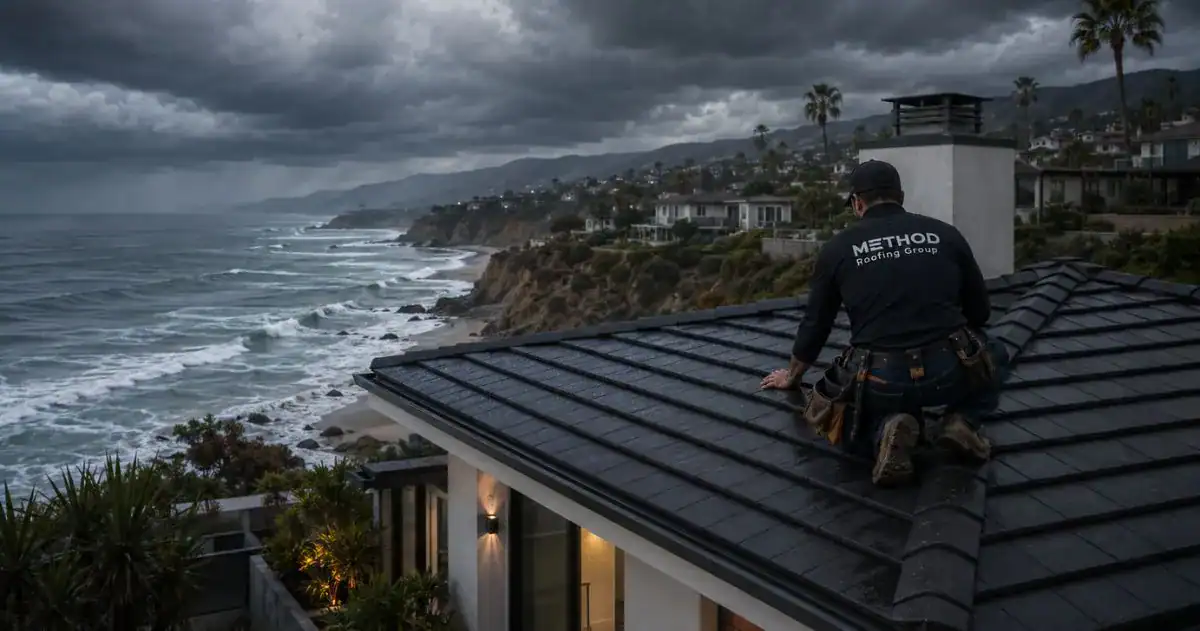
Update — July 2026: Since this guide was published, NOAA’s Climate Prediction Center has confirmed El Niño conditions are present and strengthening, with a 63% chance this event ranks among the strongest since 1950 — Los Angeles news outlets are already running “Godzilla El Niño” warnings. For Orange County homeowners the math hasn’t changed, but the clock has: October 31 remains the practical deadline for pre-storm roof work, and if your community requires HOA architectural review, a 30–45 day approval window means submitting by mid-September. A documented inspection now is what makes both timelines possible.
Key Takeaways
- NOAA confirmed El Niño 2026-27 is strengthening — Orange County sits directly in the storm track with above-normal rainfall expected December 2026 through February 2027.
- Six residential roof conditions are most vulnerable this season: cracked or slipped tiles, lifted asphalt shingles, aged flashings around skylights and chimneys, clogged gutters and downspouts, sagging fascia, and undersized valley drainage.
- Coastal OC homes face specific risks — salt air, Santa Ana wind cycles, and older tile roof systems in Newport Beach, Corona del Mar, Laguna Beach, Newport Coast, and Dana Point require earlier evaluation than inland properties.
- California’s insurance crisis makes pre-storm documentation essential — claim approval increasingly depends on dated, photo-verified roof condition reports from licensed contractors.
- HOA approval cycles extend timelines — many OC communities require architectural review board sign-off before roof work, adding 30-45 days to the process.
- Schedule your pre-storm inspection by August 31, 2026 — contractor capacity, material lead times, and permit backlogs all compress as October approaches.
El Niño roof preparation just became urgent for every Orange County homeowner from Newport Beach to Yorba Linda. NOAA confirmed in its June 2026 climate outlook that El Niño 2026-27 conditions are strengthening through winter — and Orange County sits squarely in the storm track that historically delivers above-normal rainfall, atmospheric river events, and wind-driven rain to coastal California.
For OC homeowners specifically, this El Niño arrives during a fundamentally changed insurance landscape. Claim payouts increasingly depend on documented pre-storm roof condition. Roofing contractor capacity fills by mid-September. HOA architectural review boards slow to a crawl in October. And the tile roofs common across affluent coastal Orange County — Newport Beach, Corona del Mar, Laguna Beach, Newport Coast, Dana Point — carry unique vulnerabilities that Method has documented across hundreds of pre-storm evaluations.
This guide walks Orange County homeowners through what NOAA predicts, the six residential roof conditions most vulnerable to El Niño 2026-27, why coastal OC properties need earlier preparation than inland homes, how to document your roof for insurance protection, and the HOA and scheduling realities that determine whether major work can complete before storms arrive.
What El Niño 2026-27 Means for Orange County Homes
The National Oceanic and Atmospheric Administration’s June 2026 ENSO update confirmed that El Niño conditions are strengthening across the central Pacific, with peak intensity expected December 2026 through February 2027. For Orange County, that projection carries specific implications rooted in the region’s storm history.
Historically, the 1997-98 El Niño brought 31 inches of rain to Los Angeles and Orange County — nearly double the seasonal average. Coastal communities from Huntington Beach to San Clemente flooded. Hillside homes in Laguna Beach and Corona del Mar experienced significant water intrusion. The 2015-16 El Niño underdelivered for inland zones but produced significant coastal flooding events, including atmospheric rivers that pushed multiple inches of rain in single storms.
Furthermore, NOAA’s outlook for El Niño 2026-27 anticipates:
- Above-normal precipitation across Orange County — coastal and inland
- Increased atmospheric river frequency from December through March
- Elevated wind-driven rain risk along coastal zones (Newport Beach through Dana Point)
- Santa Ana wind interruptions creating compressed dry-wet cycles that stress roof systems
- Back-to-back storm systems with limited drying time between events
For Orange County homeowners, the practical takeaway is straightforward. Any residential roof condition that survived the mild 2024-25 winter likely will not survive the 2026-27 season without intervention. Deferred maintenance becomes emergency water damage during the first significant atmospheric river.
El Niño Roof Preparation: The 6 Most Vulnerable Residential Conditions in Orange County
Effective El Niño roof preparation across Orange County starts with knowing what to look for. After documenting pre-storm evaluations across Orange County residential properties for years, Method has identified the six conditions most likely to fail during El Niño 2026-27.
1. Cracked or Slipped Tiles. Concrete and clay tile roofs — dominant across Newport Beach, Corona del Mar, Costa Mesa and much of coastal OC — crack from foot traffic, thermal cycling, and impact damage. Tiles slip out of position as underlying battens deteriorate. Individually, these are minor issues. During sustained atmospheric river events, they become water intrusion points that saturate underlayment and rot decking.
2. Lifted or Curled Asphalt Shingles. Asphalt shingle systems, common across inland OC neighborhoods like Yorba Linda, Anaheim Hills, and Villa Park, develop lifted edges and curled corners after years of UV exposure. South and west-facing slopes deteriorate fastest. Lifted shingles allow wind-driven rain to reach the underlayment during coastal storm events.
3. Aged Flashings Around Skylights and Chimneys. Skylight flashings, chimney counter-flashings, and vent penetration flashings fail more often than the field roof system itself. Sealants deteriorate. Metal flashings corrode. Additionally, the transition zones between different roof planes represent the highest-risk failure points during heavy rainfall.
Drainage and Perimeter Vulnerabilities
4. Clogged Gutters and Downspouts. Orange County homes accumulate significant debris in gutter systems — pine needles, palm fronds, jacaranda blooms, eucalyptus leaves. A single storm event can overwhelm clogged drainage, causing water to back up under roof edges and damage fascia, soffits, and interior walls.
5. Sagging Fascia and Deteriorated Soffits. Older OC homes — particularly those in established neighborhoods like Old Corona del Mar, Balboa Island, and Laguna Village — often have wood fascia and soffit systems that have deteriorated from moisture exposure. During El Niño storms, these areas become primary water intrusion points.
6. Undersized or Blocked Valley Drainage. Roof valleys — the intersections where two roof planes meet — handle the highest volume of water during storms. Undersized valleys, valleys blocked by debris, or valleys with deteriorated flashing metal will overflow during atmospheric river events, sending water directly into attic spaces.
For a documented evaluation covering all six conditions on a specific Orange County property, schedule a residential roof repair inspection or pre-storm evaluation with Method.
Why Affluent Coastal Orange County Homes Face Specific Risks
Orange County residential roof El Niño preparation isn’t uniform across the county. Coastal communities — Newport Beach, Corona del Mar, Laguna Beach, Newport Coast, Dana Point, Emerald Bay — face specific risks that inland OC homes don’t share.
Salt Air Corrosion. Homes within two miles of the Pacific experience accelerated corrosion of metal roof components: flashings, valley metal, drip edges, fasteners. Older tile roof systems in Corona del Mar and Newport Beach often have galvanized components that have corroded through — invisible until they fail during a storm.
Santa Ana Wind Interruptions. Coastal OC experiences Santa Ana wind events that create rapid humidity swings. These wind cycles stress roof systems by causing rapid expansion and contraction of tiles, shingles, and flashings. Additionally, Santa Ana events during storm season can drive rain horizontally into normally protected roof areas.
Older Tile Roof Systems. Many affluent coastal OC homes have Spanish or Mission tile roofs installed in the 1970s-1990s. The tiles themselves are essentially permanent — but the underlayment, battens, and flashings underneath have reached the end of their service life. From ground level, the roof looks fine. During an El Niño atmospheric river event, deteriorated underlayment becomes the failure point.
Complex Roof Systems and HOA-Specific Coastal Considerations
Hillside and Multi-Story Configurations. Homes in Laguna Beach, Emerald Bay, and hillside portions of Newport Coast often have complex roof configurations — multiple planes, extensive valleys, cantilevered sections, and challenging drainage paths. These roofs require more detailed pre-storm evaluation than simpler suburban rooflines.
HOA Architectural Requirements. Affluent OC communities frequently have HOA architectural review boards that must approve any roof work — including material selection, color matching, and installation methods. This adds 30-45 days to the pre-storm timeline that inland non-HOA homeowners don’t face.
Coastal OC homeowners planning El Niño 2026-27 roof preparation should begin the evaluation conversation 60-75 days earlier than inland homeowners to account for these compounded factors.
Our Newport Beach roofing team is headquartered in the city, minutes from the coastal neighborhoods where salt air does its quietest damage.
The Orange County Homeowner’s El Niño Roof Preparation Framework
Method recommends Orange County homeowners complete this framework before September 15, 2026 — earlier for coastal properties with HOA requirements.
Ground-Level Visual Inspection (Do This This Weekend):
Method does NOT recommend homeowners climb onto residential roofs. Conduct a thorough ground-level inspection from multiple angles using binoculars if available.
Look for:
- Vegetation growth in gutters or against roof edges
- Lifted, curled, or missing shingles
- Cracked, slipped, or broken tiles
- Visible flashing damage around chimneys, skylights, and vent penetrations
- Sagging gutters or downspouts pulling away from fascia
- Granule accumulation in gutter discharge zones (indicates asphalt shingle degradation)
- Visible interior ceiling staining (early warning of underlayment failure)
- Debris accumulation in valleys or against penetrations
Doing this from the ground this weekend? The free pre-season checklist covers everything on this list, plus the ridge lines, wall transitions, attic check, trees, and site drainage most people skip. Page six is a tear-off you print, carry, and mark Pass, Watch, or Fix as you walk.
When to Escalate from DIY to Professional Evaluation
Professional Evaluation (Recommended for All Homes Over 12 Years Old):
Any of the visual issues above warrants professional evaluation. Additionally, any Orange County home with the following characteristics benefits from documented pre-storm inspection regardless of visible condition:
- Any home planning to file an insurance claim in the next 12 months (documented pre-loss condition is essential)
- Tile roof system over 15 years old (particularly coastal properties)
- Asphalt shingle roof over 12 years old
- Any home with previous water intrusion history
- Any home with recent hillside movement or foundation settlement
- Any home located in an HOA requiring approval for roof work
What Method’s Written Report Includes:
Every Method residential pre-storm evaluation produces a written report designed to support insurance claims, HOA submissions, and capital planning conversations. The report includes photo documentation of every cited condition, condition scoring per roof component, drainage assessment, code compliance verification (Title 24 cool roof, Chapter 7A wildfire), and three costed options — repair, restoration, or replacement — with explicit recommendation and reasoning.
Learn more about Method’s documented evaluation process.
When Insurance Covers El Niño Damage in Orange County (And When It Won’t)
The California insurance landscape has transformed since the 2015-16 El Niño season. Multiple major carriers have exited the state entirely or stopped writing new homeowner policies. The California FAIR Plan now insures more Orange County properties than at any point in its history. Furthermore, post-storm claim denials have increased significantly when homeowners cannot produce dated, photo-verified pre-storm condition documentation.
For El Niño 2026-27 specifically, Orange County insurance adjusters increasingly require:
- Pre-storm photographic documentation of roof condition
- Written inspection reports from licensed contractors dated before the loss event
- Documented maintenance history showing the roof was actively cared for
- Confirmation that pre-existing damage was addressed before the storm
Without this documentation, coverage on legitimately storm-caused damage becomes uncertain. Properties with documented pre-storm condition reports receive faster claim processing, larger payouts, and fewer denial disputes.
Common Insurance Denial Reasons in Orange County:
- Roof age exceeds 15 years and no maintenance records exist
- Damage attributed to pre-existing conditions rather than storm event
- Homeowner deferred previously recommended repairs
- Underlying substrate damage existed before the loss event
- Homeowner cannot produce condition documentation from the past 24 months
Method’s documented advisory approach is specifically designed to produce the insurance-grade documentation that Orange County homeowners need before storm season begins.
Claim approval increasingly depends on documented pre-storm condition — here’s what California insurers now require from your roof.
HOA Considerations for Orange County Homeowners
For HOA communities, El Niño roof preparation must factor in architectural review board timelines from day one. Many affluent Orange County communities require HOA architectural review board approval before any roof work — including repairs, restoration coating, and replacement. Specifically, HOAs commonly present in Newport Beach, Corona del Mar, Laguna Beach, Newport Coast, Dana Point, Coto de Caza, Ladera Ranch, Talega, and dozens of other OC master-planned communities.
Typical HOA Roof Approval Requirements:
- Architectural review board application (often requires contractor’s insurance, license, and manufacturer certifications)
- Material specification sheets for proposed roof system Color matching approval (particularly for tile roofs)
- Design review meetings (often held monthly or bi-monthly) Written approval before permit application Sometimes: neighbor notification requirements
HOA Timeline Impact and Pre-Storm Deadlines
HOA Timeline Impact:
Adding HOA approval to the pre-storm timeline typically extends the total process by 30-45 days. For coastal OC homeowners in HOA communities, the practical deadline for beginning El Niño 2026-27 roof preparation is July 15, 2026 — not September as it would be for non-HOA properties.
Method regularly navigates HOA architectural review board processes across Orange County. Our written evaluation reports are formatted to support HOA submissions directly, and our manufacturer certifications typically satisfy approval requirements for major OC HOA communities.
Cost Expectations for El Niño Roof Preparation in Orange County
Budget-conscious El Niño roof preparation typically starts with the smallest necessary intervention — often a targeted repair or restoration coating rather than full replacement. Orange County residential roof costs run higher than California averages due to labor rates, permitting requirements, HOA compliance costs, and coastal premium pricing.
Typical HOA Roof Approval Requirements:
| Service | Typical OC Cost Range | Notes |
|---|---|---|
| Professional pre-storm inspection | $0 – $500 | Often included in eventual repair quote |
| Minor repairs (single-area) | $500 – $3,500 / sq ft | Slipped tiles, isolated flashing repair, small area shingle replacement |
| Comprehensive repair (multi-area) | $3,500 – $12,000 | Multiple conditions addressed, warranty-preserving materials |
| Restoration coating (flat roof sections) | $4 – $8 per sq ft | Extends service life 10-20 years |
| Full asphalt shingle replacement | $15,000 – $45,000 | 2,000-3,500 sq ft OC home |
| Full tile roof replacement (concrete) | $35,000 – $85,000 | Traditional tile OC home |
| Full tile roof replacement (clay) | $50,000 – $150,000+ | Affluent coastal OC properties |
Additionally, for a detailed residential roof replacement cost analysis for Orange County, see our dedicated cost breakdown page.
Cost tip for OC homeowners: Pre-storm scheduled repairs cost 3-5x less than storm-caused emergency repairs. A $2,500 documented pre-storm repair often prevents a $15,000 storm damage claim (with insurance denial risk).
When to Schedule Your Orange County Roof Inspection
Therefore, Method recommends the following scheduling framework by Orange County property type:
Active Leaks or Visible Damage: Same-day response during business hours. Active leaks during pre-storm season indicate accelerating failure — immediate evaluation prevents catastrophic storm-season damage.
Coastal OC Homes in HOA Communities: Schedule by July 15, 2026. Accounts for 30-45 day HOA approval cycles plus contractor scheduling.
Coastal OC Homes Without HOA: Schedule by August 15, 2026. Coastal salt air, older tile systems, and complex configurations require earlier evaluation.
Inland OC Homes in HOA Communities: Schedule by August 15, 2026. HOA approval timelines still apply, but weather stress patterns are somewhat lower.
Inland OC Homes Without HOA: Schedule by September 1, 2026. Standard suburban configurations with simpler evaluation and permit paths.
Across all categories, Method’s documented advisory report is designed to support the decision — not pressure it. Most residential pre-storm evaluations result in repair or targeted maintenance recommendations rather than full replacement. The work that follows is whatever the property actually needs.
Frequently Asked Questions About Orange County El Niño 2026-27 Roof Preparation
Common El Niño roof preparation questions from Orange County homeowners cover timing, insurance, HOA requirements, and how to spot vulnerable conditions before storms arrive.
When does El Niño 2026-27 hit Orange County?
NOAA’s June 2026 outlook projects El Niño conditions strengthening through summer, with the first significant atmospheric river events typically arriving in November and peak intensity expected December 2026 through February 2027. Orange County homeowners should treat October 31, 2026 as the practical deadline for completing any pre-storm roof work.
How much rain does El Niño typically bring to Orange County?
Strong El Niño events historically deliver 150-200% of normal rainfall to Orange County. The 1997-98 El Niño brought more than 25 inches of rain to Santa Ana — nearly double the seasonal average. NOAA’s 2026-27 outlook anticipates above-normal precipitation across the county with elevated atmospheric river frequency.
Does homeowners insurance cover El Niño storm damage in Orange County?
Most Orange County homeowners insurance policies cover wind-driven rain and storm-caused roof damage. However, claim approval increasingly depends on documented pre-storm roof condition. California insurance carriers deny claims when damage can be attributed to pre-existing wear, deferred maintenance, or conditions that existed before the storm event.
My roof looks fine from the ground. Do I really need an inspection before El Niño?
For Orange County homes over 12 years old (asphalt shingle) or 15 years old (tile), yes. Many failure modes — deteriorated underlayment, corroded flashings, aged battens — are invisible from ground level but become storm-season disasters. Additionally, insurance claim documentation becomes far easier with a dated pre-storm inspection on file.
Do I need HOA approval for pre-storm roof work in Orange County?
Most affluent Orange County communities require HOA architectural review board approval for any roof work — including repairs, coatings, and replacement. HOAs typically extend project timelines by 30-45 days. Newport Beach, Corona del Mar, Laguna Beach, Newport Coast, Dana Point, Coto de Caza, Ladera Ranch, and dozens of other OC communities have active architectural review requirements.
What’s the difference between repair, restoration, and replacement for residential roofs?
Repair addresses specific localized damage on a fundamentally sound roof system. Restoration coating (for flat or low-slope roof sections) extends service life 10-20 years at a fraction of replacement cost. Replacement removes the existing system entirely — appropriate when substrate damage, extensive underlayment failure, or manufacturer warranty end-of-life eliminates other options. Method’s evaluation determines which is right for your specific Orange County property.
Can I delay roof work until after El Niño 2026-27 storms?
For minor cosmetic issues, possibly. For any condition involving active leaks, cracked or slipped tiles, aged flashings, or deteriorated underlayment, delay creates significant risk. Storm-caused emergency repairs cost 3-5x more than scheduled pre-storm work, and insurance coverage on damage from neglected conditions becomes uncertain.
Are roofing contractors busier during El Niño years in Orange County?
Significantly. Orange County contractor capacity typically reaches saturation by mid-September during El Niño years — earlier in coastal HOA communities. Material lead times extend for specialty tile matching, Class A fire-rated systems, and manufacturer-specific components. Homeowners who wait until storm-season emergency conditions face limited contractor choices and premium pricing.
Do you handle HOA architectural review board submissions for Orange County communities?
Yes. Method regularly navigates HOA architectural review processes across Orange County. Our written evaluation reports are formatted to support HOA submissions, and our manufacturer certifications typically satisfy approval requirements for major OC HOAs including Newport Beach, Corona del Mar, Laguna Beach, Newport Coast, Dana Point, Coto de Caza, and Ladera Ranch.
How do I verify Method Roofing Group before hiring?
Three steps. First, verify CSLB License #1157257 at California’s Contractors State License Board portal — confirm it’s active and in good standing. Second, request Method’s written scope of work with manufacturer compatibility verification before any project begins. Third, review Method’s documented evaluation approach and manufacturer certifications on the About page.
About This Article
This article was written by the Method Roofing Group team, drawing on founder Jeff Moreno’s combined manufacturer and contractor operations experience across the industry’s largest commercial and residential roofing names. Method Roofing Group provides documented commercial, residential, and industrial roofing services across Southern California — including comprehensive residential pre-storm preparation, tile roof restoration, asphalt shingle replacement, and HOA architectural review board coordination throughout Orange County. Learn more about Method Roofing Group.
Cost figures reflect 2026 Orange County residential installed pricing. Verify current pricing with a project-specific estimate. Method Roofing Group operates under CSLB License #1157257.
Need a Pre-Storm Orange County Roof Inspection?
Method’s documented El Niño roof preparation approach delivers residential inspections and pre-storm evaluations across Orange County — Newport Beach, Corona del Mar, Laguna Beach, Newport Coast, Dana Point, Huntington Beach, Costa Mesa, Irvine, Anaheim, Yorba Linda, and every OC community.
Every inspection includes ground-level and drone-supported evaluation, full photo documentation, an annotated roof plan, condition scoring per component, and a written advisory report delivered within 24-48 hours — designed to support insurance claims, HOA submissions, and homeowner decision-making before El Niño 2026-27 storms arrive.
Schedule a pre-storm inspection below — or call (949) 866-3011 to book by phone.
Same-day response for active leaks during business hours. HOA-savvy scheduling for Orange County communities.

