Roof Replacement With Solar Panels: Yes, They Come Off — Here’s What That Actually Costs You
By Method Roofing Group | August 2026 | 9 min read
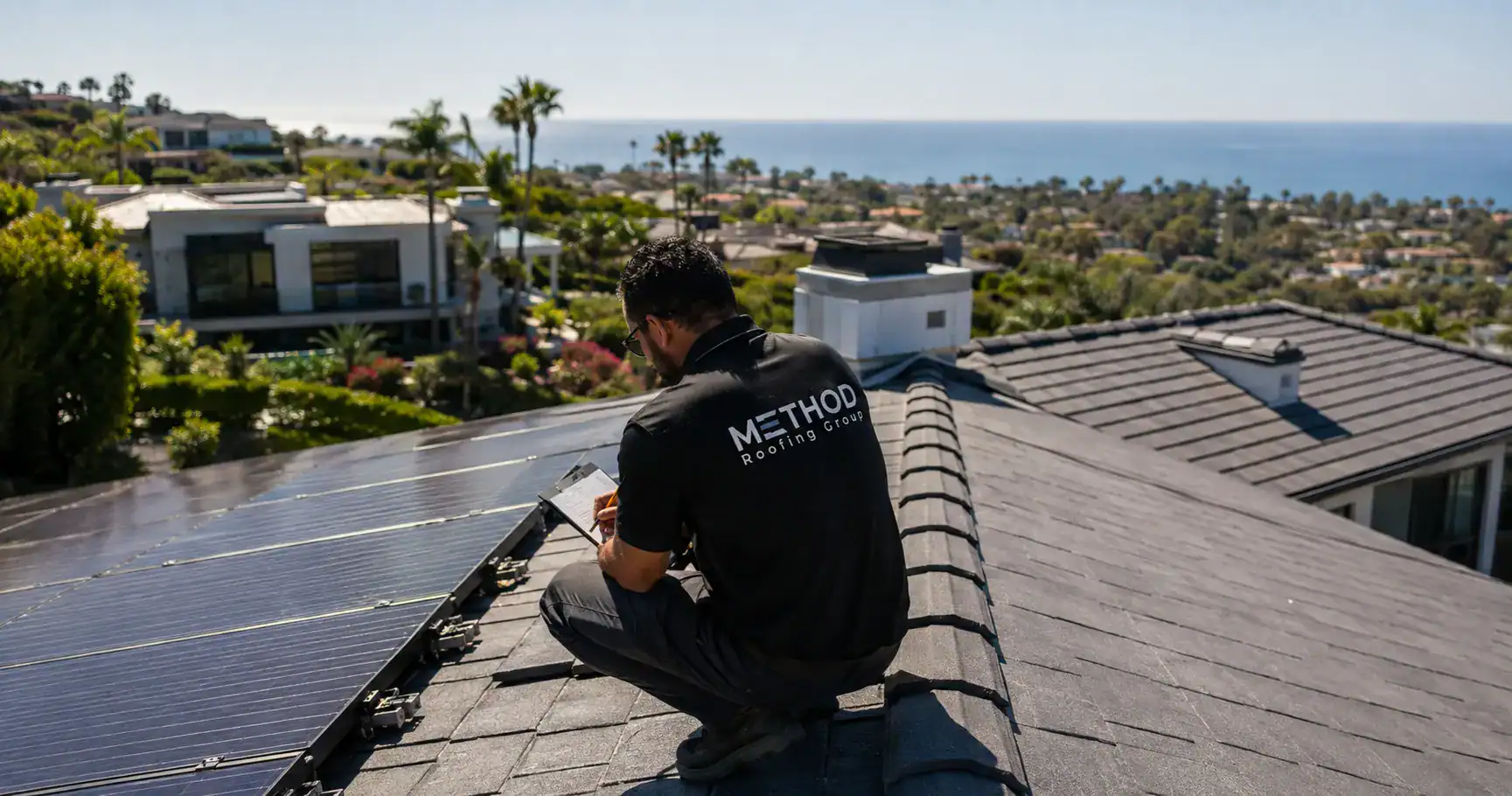
A roof replacement with solar panels is three jobs, not one — detach, reroof, reset — and in California the contractor who does your roof is usually not allowed to touch your panels. Here is what that actually costs, who is legally permitted to do it, and what changed this year.
Key Takeaways
- The panels always come off. — A roof replacement with solar panels requires a full detach and reset; there is no way to reroof underneath a mounted array.
- Your roofer probably can’t legally put them back. — Los Angeles County and the City of San Diego both require a C-10 or C-46 licensed contractor to reinstall a rooftop PV system after a reroof.
- Detach and reset is a second project with a second permit. — Industry-reported labor runs roughly $200 to $300 per panel, and SoCal jurisdictions require a separate PV permit on top of the roofing permit.
- Some panel warranties void the moment the modules come down. — Qcells excludes any module that has been “uninstalled, reinstalled or otherwise altered.” Others, like REC, are far more forgiving. Read yours first.
- The federal solar credit never paid for your roof, and now it pays for nothing. — Section 25D expired for anything not installed and operating by December 31, 2025, and ordinary roof decking never qualified in the first place.
The Hook
A roof replacement with solar panels is never just a roofing job. A homeowner in Yorba Linda found that out in June, when she called us about three stains on a bedroom ceiling. The roof was twenty-two years old. The solar array on top of it was nine. Nobody had told her, back in 2017, that she was mounting a twenty-five-year system onto a roof with maybe five years left.
That call is not unusual anymore — it is becoming the standard call. Across Southern California, a large cohort of homes went solar between 2010 and 2018, often onto roofs that were already middle-aged. Those roofs are now failing underneath perfectly healthy panels. So yes: the panels come off, and it costs real money. Here is exactly what happens, who is legally allowed to do it, and what changed this year that makes the timing matter more than it used to.
Roof replacement with solar panels: do the panels have to come off?
Yes. A roof replacement with solar panels requires removing every panel, the racking, and the mounting hardware, because the new roof covering has to go down across the entire deck. There is no method for reroofing underneath a mounted array. Partial repairs around panels are sometimes possible, but a replacement is not.
That distinction matters financially, so it is worth being precise about it. A localized repair often leaves the solar untouched. Think a few cracked tiles on an open slope, or a flashing detail well away from the array. A replacement cannot. Once the tear-off crosses under the racking, the array has to be down.
This is also why the repair-versus-replace decision gets more expensive to postpone when panels are involved. If you are weighing that call, our guide to roof repair vs. roof replacement walks through where the line actually sits.
Who can legally remove and reinstall your solar panels in California?
In Los Angeles County and the City of San Diego, a C-10 (electrical) or C-46 (solar) licensed contractor must perform the PV reinstallation. A C-39 roofing license does not cover it. Los Angeles County states the rule plainly in its building code manual, and San Diego repeats it in its permit bulletin.
Most homeowners never hear about this part. It is also the fastest way to spot a proposal nobody thought through.
Here is the actual language, from Los Angeles County Public Works Building Code Manual 1512-A1:
“The Contractors State License Board requires that reroofing be performed by a C-39 licensed contractor and the reinstallation of rooftop mounted PV systems be performed by a C-10 or a C-46 licensed contractor. Otherwise, an A or B licensed contractor may apply for both trades.”
The City of San Diego’s Information Bulletin 301 says the same thing: “The installation of the PV system for the re-roofing purpose shall be performed by a qualified contractor holding a C-10 or C-46 license.”
The state licensing definitions back this up. The Contractors State License Board describes a C-46 solar contractor as one who “installs, modifies, maintains, and repairs thermal and photovoltaic solar energy systems.” Its C-39 roofing definition covers products and surfaces that “seal, waterproof and weatherproof structures.” Electrical and PV scope appears nowhere in it.
What this means for you: ask any roofer quoting your job who is performing the detach and reset, and what license they hold. If the answer is vague, that is your answer.
Method Roofing Group is a licensed California roofing contractor. We do not perform the electrical scope of a solar detach and reset, and we will not tell you otherwise — we coordinate with a licensed C-10 or C-46 solar contractor, sequence the two trades so the roof is never left open, and make sure both permits are pulled. A roofer who offers to handle your panels personally is either licensed to do it or is telling you something that should worry you.
What does solar panel removal and reinstallation actually cost?
A roof replacement with solar panels carries three separate costs: the roof, the detach and reset, and a second permit. Industry sources report roughly $200 to $300 per panel in detach-and-reset labor. For a typical residential system, that lands between about $1,500 and $6,000. That is separate from the roof itself, and separate from the second permit most Southern California jurisdictions require.
We want to be honest about the quality of that number. It comes from solar marketplace and cost-guide sources, not from a licensed trade association survey — no CALSSA or federal dataset publishes a detach-and-reset labor figure. Treat it as a planning range, not a quote.
| Line item | What to expect | Why it’s separate |
|---|---|---|
| Roof replacement | Varies by material, slope, and deck condition | Your roofing contract |
| Solar detach and reset | Industry-reported ~$200–$300 per panel | A C-10 or C-46 contractor handles it |
| Second permit | Required in LA County and San Diego | A distinct PV permit, with its own inspection |
| Possible code upgrades | Varies — see below | Depends on your jurisdiction and system age |
For the roofing side of that stack, our breakdown of residential roof replacement cost gives current per-square-foot figures by material.
Will taking your panels down cost you your old net metering rate?
Probably not — but confirm it in writing before anything comes off the roof. California’s utilities grandfather NEM 1.0 and NEM 2.0 customers for 20 years from interconnection. The published trigger for losing that status is increasing your system’s capacity beyond the greater of 1 kW or 10 percent of the original size.
That threshold appears consistently across Southern California Edison and SDG&E documentation. No utility document names a like-for-like detach and reset — same panels, same capacity, same location — as a trigger.
But here is the honest version: it is also not named anywhere as safe. We could not find a CPUC decision or a utility tariff sheet that addresses the reroof scenario directly, one way or the other. Given what a legacy rate is worth over twenty years, that silence is not something to gamble on.
So do this: before the array comes down, get written confirmation from your utility that a like-for-like reinstall preserves your legacy status. Then resist the temptation to add panels during the reroof. Adding capacity is exactly the move that transitions you onto today’s rates.
What changed in 2026, and why does it make the timing matter?
Two things became permanent this year. In March 2026 the California Court of Appeal upheld the CPUC’s Net Billing Tariff, and in June 2026 the California Supreme Court declined to review that decision. Separately, the federal 25D residential solar credit expired for any system not installed and operating by December 31, 2025.
The litigation history is worth stating precisely, because most coverage gets it wrong. The CPUC adopted Decision 22-12-056 in December 2022, applying the Net Billing Tariff — commonly called NEM 3.0 — to interconnection applications submitted on or after April 15, 2023. It cut export compensation by roughly 75 to 80 percent compared with NEM 2.0.
The challenge went up, came back down, and went up again. The California Supreme Court did weigh in during 2025. But it ruled on a procedural question — how appellate courts should review CPUC decisions — not on whether NEM 3.0 was sound. On remand, the First Appellate District affirmed the tariff on March 9, 2026, in a published opinion. The Supreme Court declined further review on June 10, 2026.
Meanwhile, the federal credit closed. The IRS is unambiguous that an expenditure counts when “the original installation of the item is completed” — so a contract signed or a deposit paid in 2025 for a system finished in 2026 does not qualify.
Why this matters to a reroof: the growth in California solar work is no longer in new installations. It is in maintaining and relocating arrays that already exist, on roofs that are aging out beneath them. If your panels are already up, your decisions from here are about protecting what you have.
Does the solar tax credit cover the new roof?
No, and it never really did. The federal 25D credit covered solar electric property. If a contractor ever told you the credit would cover a reroof as part of a solar project, they were wrong at the time. The credit is now expired regardless.
The IRS instructions for Form 5695 draw the line clearly. Solar shingles and tiles that themselves generate electricity could qualify, because they serve two functions. But “structural components such as a roof’s decking or rafters that serve only a roofing or structural function” did not.
If a contractor ever told you a reroof would be covered because it was part of a solar project, that was wrong when they said it. Any federal tax credit language still sitting on a roofing company’s website today is stale.
Does removing your panels void your warranties?
It depends entirely on the brand, and the differences are dramatic. Some module manufacturers void coverage the moment anyone uninstalls a panel. Others exclude only the damage that improper work causes. Roofing manufacturers generally keep their shingle warranty intact, but almost all of them make you pay to move the solar.
This is the section worth reading your own paperwork over.
| Manufacturer | What the warranty actually says |
|---|---|
| Qcells (panels) | Excludes modules “moved from its original installation location, uninstalled, reinstalled or otherwise altered.” A hard exclusion. |
| REC (panels) | Excludes damage from removal or modification “by someone other than a qualified service technician” — narrower, and does not void the whole warranty. |
| Tesla (panels) | Permits third-party removal, but is “not responsible for any workmanship issues from third-party contractors.” Code upgrades are the customer’s cost. |
| GAF (shingles) | Solar does not affect the shingle warranty, but if there is ever a shingle issue, removing the panels is the owner’s expense. GAF also recommends that shingles under PV be less than five years old. |
| CertainTeed (shingles) | “Costs associated with removal or replacement of overburden (items installed over the shingles, including but not limited to, solar panels, satellite dishes and gardens) are the sole responsibility of the property owner.” |
| Owens Corning (shingles) | Standard warranty won’t cover removal costs. Its Platinum Solar PROtect program covers detach and reset up to $10,000, but only if an OC Platinum Preferred Solar PRO contractor installed the roof and registered it within 60 days. |
Before you schedule a roof replacement with solar panels, pull your panel warranty and read the exclusions. That GAF recommendation — shingles under PV before panels go on
That GAF recommendation — shingles under five years old before panels go on — is the single most useful line in this entire article, and it is the one almost nobody hears before they go solar.
Will your old system have to meet today’s electrical code when it goes back up?
Possibly, and this is genuinely unsettled. California’s current electrical code took effect January 1, 2026 and follows the 2023 NEC. Rapid shutdown requirements date to the 2017 NEC cycle, so most systems from before 2018 predate them. Your local building department decides whether a legacy system must comply when it goes back up.
Neither Los Angeles County’s manual nor San Diego’s bulletin addresses this directly. San Diego’s language leans one way — it requires the original approved plan set with the permit application and allows “no alteration of the original equipment or system” — which reads like re-approving the original design rather than demanding a new one. But it does not say so outright.
Contractors will tell you it goes both ways depending on the jurisdiction, and in our experience that is accurate. The right move is to ask your building department the question in writing before the array comes down, because retrofitting rapid-shutdown equipment onto an older system is a real cost that belongs in the budget from day one, not as a change order in week three.
How do you sequence a reroof and solar so you only pay once?
Replace the roof first, then install solar. The Department of Energy’s guidance is direct: iif the roof will need replacement during the life of the PV system, replace it first. A twenty-five-year array on a fifteen-year-old roof guarantees you will pay for a detach and reset you could have avoided.
The mismatch is structural, and it is why a roof replacement with solar panels so often arrives sooner than the owner expects. Panels are built to run twenty-five to thirty years. An asphalt roof in a hot, high-UV Southern California climate does not. Mounting the longer-lived system onto the shorter-lived one is how homeowners end up paying twice.
What is striking is that no numeric standard exists. There is no published rule saying “your roof needs X years of life left before solar.” The DOE guidance is qualitative. GAF’s five-year recommendation is the closest thing to a hard number anyone in the industry has put in writing — and it comes from a shingle manufacturer, not a solar one.
That gap is exactly why a documented roof evaluation before a solar install is worth more than an opinion. If you want to know where your roof actually sits, start with how long a residential roof lasts in Southern California, then have someone document the deck condition rather than estimate it.
One more thing worth watching: FM Approvals now maintains a standard, FM 4484, covering retrofit roof coatings that go under roof-mounted rigid PV. Its April 2026 data sheet recommends installing an approved retrofit coating before glass-backed panels go on. Fire behavior underneath a solar array is an active area of standards development — which is one more argument for getting the roof right before the panels go up.
Frequently Asked Questions
Can my roofing contractor take the panels off himself?
Removal and reinstallation of a rooftop PV system requires a C-10 or C-46 licensed contractor in Los Angeles County and the City of San Diego. A C-39 roofing license does not cover PV or electrical work. An A or B licensed contractor may pull both trades. Ask who is doing it and what they hold before you sign.
Do I need a separate permit to put my panels back?
Yes, in the Southern California jurisdictions we checked. Los Angeles County requires a distinct PV reinstallation permit alongside the roofing permit, with its own inspection. San Diego requires the original approved record plan set with the submittal and may require a pre-removal inspection.
Should I replace my roof before installing solar?
If your roof will need replacement within the life of the solar system, yes. The DOE encourages replacing first. GAF recommends that shingles under PV panels be less than five years old. A documented roof evaluation before you commit to solar is the cheapest step in the entire sequence.
Will I lose my NEM 1.0 or NEM 2.0 rate?
Legacy status runs 20 years from interconnection, and the published trigger for losing it is increasing capacity beyond the greater of 1 kW or 10 percent. No document lists a like-for-like reinstall as a trigger, and none explicitly protects it either. Get written confirmation from your utility first, and do not add panels during the reroof.
How long does a roof replacement with solar panels take?
A roof replacement with solar panels takes longer than a standard reroof, because it is three sequenced jobs: detach, reroof, reset. a different licensed contractor handles the detach and reset, and the second permit carries its own inspection. Build the schedule around the permit and inspection timing, not just the roofing days.
Does my homeowners insurance cover any of this?
Detach and reset for a planned replacement is a maintenance cost, not a covered loss. If a covered event caused the damage, the analysis changes — our post on code upgrade coverage explains what your policy may owe beyond the roof itself.
About This Article
The Method Roofing Group team wrote and reviewed this article, led by founder Jeff Moreno, whose background spans roofing manufacturer operations and contractor field operations across Southern California. Method Roofing Group provides residential and commercial roof evaluations, repair, replacement, and restoration across Orange County, Los Angeles County, San Diego County, the Inland Empire, and Ventura County.
Regulatory and licensing details come from the Contractors State License Board, Los Angeles County Public Works, and the City of San Diego. Tax and utility details come from the IRS and the California Public Utilities Commission. All are current as of August 2026. This article offers general information, not tax or legal advice. Cost figures reflect industry-reported ranges and vary by system size, roof complexity, and jurisdiction. Method Roofing Group holds California contractor license CSLB #1157257.
Find Out Whether Your Roof Can Outlive Your Solar
A roof replacement with solar panels is the most expensive way to buy the same roof twice. Before you pay to take an array down — or put one up — you should know exactly how much roof you have left. A Method evaluation documents deck condition, remaining service life, and any detail that will complicate a detach and reset, with dated photos and a written recommendation you keep either way.
Request an evaluation below — or call (949) 866-3011 to speak with our team directly.

