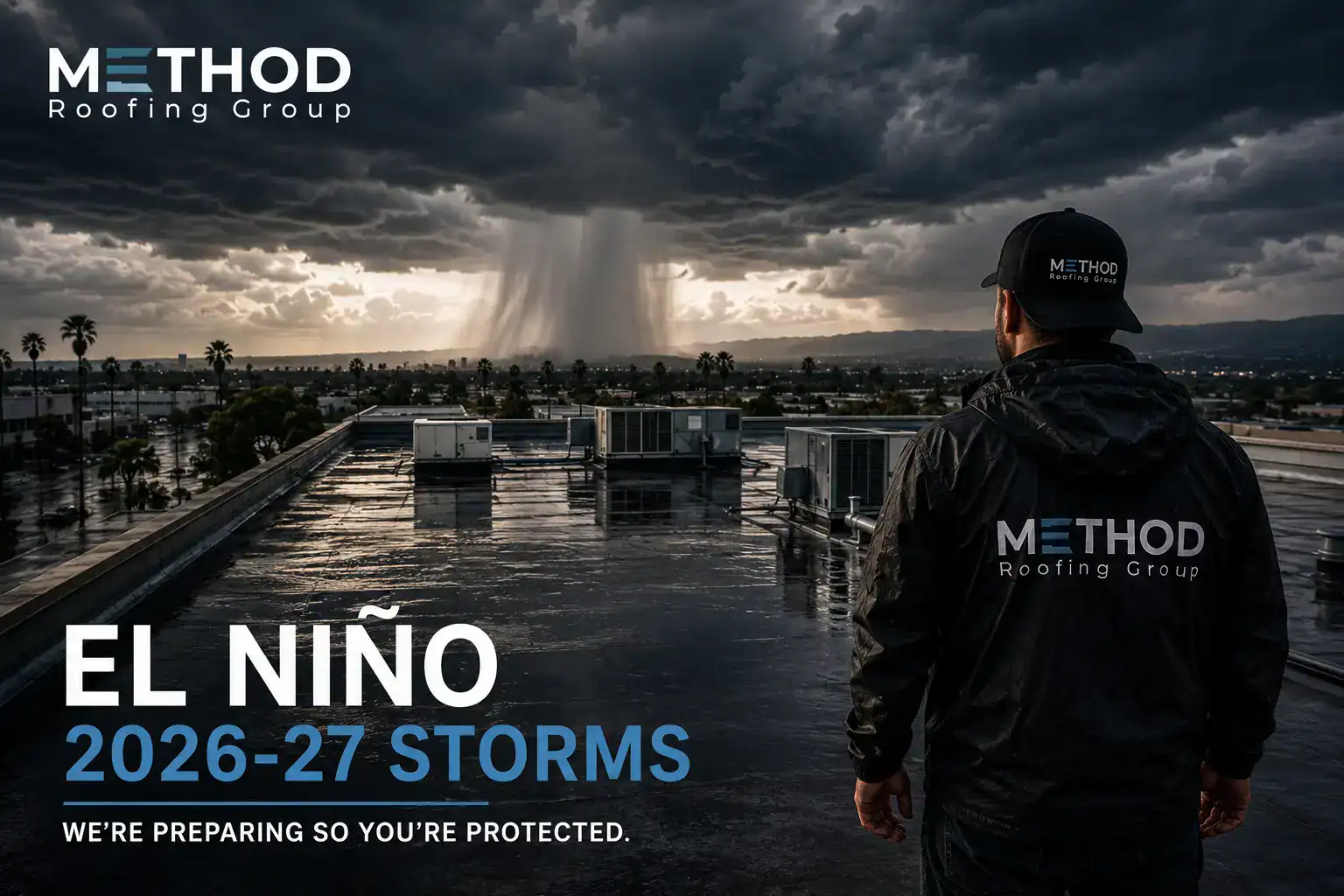
How to Prepare Your Southern California Roof for El Niño 2026-27 Storms
By Method Roofing Group | June 2026 | 8 min read
Update — July 2026: The outlook has escalated since this guide was published. NOAA’s Climate Prediction Center now confirms El Niño conditions are present and strengthening, and gives this event a 63% chance of ranking among the strongest on record since 1950 — Southern California forecasters are already using the phrase “Godzilla El Niño.” Peak storm impacts are still projected for November through January, which means the preparation window is open now and closes as contractor schedules fill. If your roof hasn’t had a documented inspection this year, schedule it before storm season does it for you.
El Niño 2026-27 roof preparation just became urgent for every Southern California property owner — NOAA first confirmed in its June 2026 climate outlook that the El Niño 2026-27 season is strengthening through the winter, and Southern California sits squarely in its track. For property owners and managers across the region, this is the second major El Niño event in a decade, following the 2015-16 season. However, this one arrives during a California insurance crisis that has fundamentally changed how storm damage claims get evaluated, paid, and denied.
Key Takeaways
- NOAA confirmed El Niño 2026-27 is strengthening — above-normal rainfall expected across all six Southern California counties, peaking December 2026 through February 2027.
- Six roof conditions are most vulnerable this season: aging single-ply membranes, cracked tile or lifted shingles, ponding water zones, compromised flashings, aged drainage systems, and fire-damaged areas from the 2024-25 wildfire season.
- California’s insurance crisis means pre-storm documentation is now essential — claim approvals depend on dated, photo-verified roof condition reports from licensed contractors.
- September 15, 2026 is the practical deadline for major roof work. Contractor capacity, material lead times, and permit timelines all compress as storm season approaches.
- Commercial property managers should complete pre-storm evaluations 60–90 days before October. Residential homeowners should schedule 30–45 days before storms arrive.
- Verify any contractor’s CSLB license, manufacturer certifications, and insurance coverage before scheduling — Method operates under CSLB License #1157257.
El Niño 2026-27 roof preparation matters more this year than in any season since 1997-98. Insurance carriers now require documented pre-storm condition reports to process claims. Material lead times have extended. Contractor capacity fills up by mid-September. Furthermore, the difference between a property that weathers the storms and one that floods, leaks, or files denied insurance claims often comes down to decisions made in July, August, and early September.
This pillar guide walks through what NOAA actually predicts, the six roof conditions most vulnerable to El Niño 2026-27 storms, separate preparation frameworks for commercial property managers and residential homeowners, why documentation matters more this year, and when to schedule before contractor capacity disappears.
What NOAA Predicts for Southern California in El Niño 2026-27
The National Oceanic and Atmospheric Administration’s Climate Prediction Center confirmed in its June 2026 ENSO update that sea surface temperatures across the central Pacific have crossed the El Niño threshold and continue to strengthen. Notably, the trajectory points toward a moderate-to-strong El Niño event peaking December 2026 through February 2027.
For Southern California, historical El Niño patterns provide the clearest forecast. The 1997-98 El Niño delivered nearly twice the normal rainfall to Los Angeles. The 2015-16 event brought atmospheric river after atmospheric river to coastal counties. Both seasons caused widespread roof failures — particularly on aging flat commercial roofs and tile residential systems where minor existing damage rapidly became major water intrusion.
Specifically, NOAA’s outlook for El Niño 2026-27 anticipates:
- Above-normal precipitation across all six Southern California counties Method serves — Orange, Los Angeles, Riverside, San Bernardino, San Diego, and Ventura
- Increased frequency of atmospheric river events from December through March
- Elevated wind-driven rain risk along coastal and foothill zones
- Compressed storm intervals (back-to-back systems with limited drying time between events)
For property owners, the practical implication is straightforward. Any existing roof condition that survived the 2024-25 winter likely will not survive the 2026-27 season without intervention. Today’s deferred maintenance becomes next month’s emergency leak call.
The 6 Most Vulnerable Roof Conditions Going Into El Niño 2026-27
After conducting hundreds of pre-storm roof evaluations across Southern California, Method has identified the six conditions most likely to fail during El Niño 2026-27. Each one represents a documented intervention point — a decision a property owner can act on now to prevent a much larger problem later.
1. Aging Single-Ply Membranes (Commercial — TPO, PVC over 15 years). Single-ply membranes installed before 2011 are reaching the end of their service life. Seam adhesion weakens. Membrane thickness drops below the manufacturer’s warranty threshold. Above all, hidden moisture accumulates beneath the membrane where infrared scanning is the only reliable detection method.
2. Cracked Tile and Lifted Shingles (Residential). Concrete and clay tile systems crack from thermal cycling, foot traffic, and impact damage. Asphalt shingle systems develop lifted edges, granule loss, and curled corners — particularly on south and west-facing slopes that receive the heaviest UV exposure.
3. Ponding Water Zones on Flat Roofs. Standing water within 48 hours of rainfall indicates either drainage failure or substrate sag. Both conditions accelerate membrane breakdown and signal underlying structural issues. In addition, ponding voids most manufacturer warranties.
4. Compromised Flashings. Penetrations, perimeters, and transition zones fail more often than the field membrane itself. Furthermore, HVAC curb flashings, skylight flashings, parapet wall flashings, and pipe boot flashings deteriorate faster than the surrounding roof system.
5. Aged Drainage Systems and Clogged Drains. Internal drains, scuppers, gutters, and downspouts that haven’t been inspected since the last storm season frequently contain debris, vegetation, or sediment buildup. During El Niño 2026-27 storms, a single clogged drain can flood thousands of square feet of roof area within an hour.
6. Fire-Damaged Areas from the 2024-25 Wildfire Season (Chapter 7A Intersection). Properties impacted by the 2024-25 wildfire season carry compounded risk. Smoke and ember damage compromises roof systems in ways that aren’t always visible. Additionally, California Chapter 7A wildland-urban interface fire-rated requirements may apply to any replacement work.
For a documented evaluation of all six conditions on a specific property, schedule a commercial roof inspection or residential roof repair consultation through Method.
How Commercial Property Managers Should Prepare for El Niño 2026-27
Commercial property managers face a different El Niño 2026-27 roof preparation challenge than residential homeowners. The stakes are higher. The documentation requirements are stricter. The capital approval timelines are longer. Therefore, the preparation work must start earlier.
Method recommends commercial property managers complete the following framework before September 15, 2026:
For a deeper walkthrough of what a complete commercial inspection covers, see Method’s 12-point commercial roof inspection checklist for Southern California property managers — the same documented framework applied on every evaluation.
Pre-Storm Documentation Checklist (Insurance-Grade):
- Complete NRCA-aligned visual inspection with photo documentation of every condition cited
- Infrared moisture scan on all flat and low-slope roof areas (detects saturated insulation invisible to the eye)
- Drainage system inspection with depth measurements on any ponding zones
- Condition scoring per component on a documented 1–10 scale
- Written advisory report including 10/20/30-year cost-of-ownership analysis for repair, restoration, and replacement options
- Manufacturer warranty status confirmation
- Code compliance verification (Title 24 cool roof, Chapter 7A where applicable)
That’s the documented version we run — infrared, condition scoring, written advisory. The free pre-season checklist is the one you can run yourself before we get there: ten low-slope points, plus a tear-off page your maintenance team marks up on site.
Capital Planning Conversation Framework:
Property managers reporting to boards, owners, or finance teams need a structured way to present pre-storm recommendations. Method’s written advisory report provides exactly this format. Specifically, the report presents three costed options (repair, restoration, replacement) with explicit recommendation and reasoning — the same document that survives the conversation when Method isn’t in the room.
Tenant Communication Timeline:
For occupied commercial properties, tenant communication should begin 30 to 45 days before any major roof work. Subsequently, scheduling around tenant operations becomes increasingly difficult as October approaches and businesses ramp up for holiday season.
30/60/90-Day Prep Timeline:
- 90 days out (July): Schedule evaluation, receive written advisory report, present to ownership/board
- 60 days out (August): Capital approval, contractor scope finalization, material specification
- 30 days out (early September): Permit issuance, crew scheduling, tenant notification
- Pre-storm (mid-September): Work completion, final documentation, insurance file update
Multi-property portfolios should add 30 days to each milestone — coordination across properties extends every phase. For documented portfolio-level pre-storm evaluation programs, contact Method to discuss the evaluation process.
How Southern California Homeowners Should Prepare for El Niño Storms
Residential El Niño 2026-27 roof preparation operates on a different timeline and budget than commercial work, but the underlying principle is identical. Document the condition. Make informed decisions. Avoid the storm-season emergency call when contractor availability disappears.
Safe Ground-Level Visual Inspection Guide:
Method does not recommend homeowners climb onto residential roofs. Instead, conduct a thorough ground-level inspection from multiple angles using binoculars if available. Look for:
- Lifted, curled, or missing shingles (particularly on south and west-facing slopes)
- Cracked, slipped, or broken tiles
- Visible flashing damage around chimneys, skylights, and vent penetrations
- Sagging gutters or downspouts pulling away from fascia
- Granule accumulation in gutters or downspout discharge zones (asphalt shingle degradation)
- Visible interior ceiling staining (catches early leaks before storm season arrives)
When to Call a Professional Versus DIY:
Any of the above conditions warrants professional evaluation. Likewise, any roof over 12 years old benefits from a documented pre-storm inspection regardless of visible condition. Method conducts residential evaluations on all major Southern California residential systems — asphalt shingles, concrete tile, clay tile, standing seam metal, and synthetic composite systems.
Questions to Ask Any Roofing Contractor:
Before engaging any contractor for pre-storm work, homeowners should verify:
- Active California Contractor’s State License Board (CSLB) license (Method holds CSLB License #1157257)
- General liability and workers’ compensation insurance
- Manufacturer certifications for the systems on your roof
- Written scope of work with material specifications before any work begins
- Photo documentation practices throughout the project
- Warranty terms (both manufacturer and contractor labor warranty)
Cost Expectations:
Pre-storm residential evaluations typically range from no-cost to several hundred dollars depending on property size and scope. Most reputable contractors include evaluation costs in the eventual repair quote. However, the value of the written documentation often exceeds the inspection cost itself — particularly when an insurance claim follows.
Why El Niño 2026-27 Documentation Matters More Than Past Storm Seasons
The California insurance landscape transformed between the 2015-16 El Niño season and today. Carriers have exited the state. The California FAIR Plan now insures more properties than any single private carrier. Furthermore, post-storm claim denials have increased significantly when property owners cannot produce pre-storm condition documentation.
For El Niño 2026-27 specifically, insurance adjusters increasingly require:
- Pre-storm photographic documentation of roof condition
- Written inspection reports from licensed contractors dated before the loss event
- Documented maintenance history
- Confirmation that any pre-existing damage was actively addressed
Without this documentation, claim payouts shrink or disappear entirely — even on legitimately storm-caused damage. Properties with documented pre-storm condition reports receive faster claim processing, larger payouts, and fewer denial disputes.
This is precisely why Method’s documented advisory approach matters more in El Niño 2026-27 than any previous season. Every Method evaluation produces a written report — typically 8 to 16 pages — designed to be shared with stakeholders, finance teams, and insurance carriers. The report holds up to review. It travels well. It survives the post-storm conversation when Method isn’t in the room.
The Pre-Storm Window: Why September Is the Hard Deadline for Major Work
Contractor capacity in Southern California fills up by mid-September every storm season — and El Niño years compress that window further. By October, most reputable contractors have scheduling backlogs of 60 days or more. By November, the only available crews are typically the ones property owners should avoid hiring.
Material lead times compound the problem. Single-ply membrane manufacturers, tile suppliers, and specialty coating producers all see demand spikes in August and September. Specialty materials — Title 24 cool roof systems, Chapter 7A fire-rated assemblies, manufacturer-specific replacement components — can carry six to eight week lead times even during normal seasons.
Permit and scheduling delays add additional friction. California municipalities slow during the holiday season. Permit reviewers take vacation. Inspection appointments become harder to book.
The practical deadline for any major roof work intended to be complete before El Niño 2026-27 storms peak: work must be scoped and approved by August 31, 2026. Work scoped after Labor Day weekend faces material delays, contractor scheduling pressure, and weather-driven completion risk.
To start the evaluation conversation now, request a free pre-storm roof inspection through Method.
When to Schedule Your El Niño 2026-27 Roof Inspection
Method recommends the following scheduling framework by property type:
Active Leaks or Visible Damage: Same-day response during business hours. Active leaks during pre-storm season indicate either accelerating failure or unidentified earlier damage. Both warrant immediate evaluation.
Single-Family Residential (Standard Evaluation): Schedule within 14 days of decision. Evaluation typically completes in 1 to 2 hours on-site, with written report delivered within 48 hours.
Commercial Single Property: Schedule within 30 days of decision. Evaluation takes 2 to 4 hours on-site for standard commercial properties, with written report delivered within 48 hours.
Commercial Multi-Property Portfolio: Schedule within 60 to 90 days of decision. Portfolio evaluations require coordination across multiple sites, multiple tenants, and multiple capital planning cycles.
HOA and Multi-Unit Residential: Schedule within 45 days of decision. HOA board approval cycles and tenant coordination requirements extend evaluation timelines.
Across all categories, the documented advisory report Method delivers is designed to support the decision — not pressure it. Property owners receive three costed options (repair, restoration, replacement) with explicit recommendation and reasoning. Approximately 65% of Method’s pre-storm evaluations result in repair or restoration recommendations rather than full replacement. The work that follows is whatever the property actually needs.
Frequently Asked Questions About El Niño 2026-27 and Your Roof
When does El Niño 2026-27 hit Southern California?
NOAA’s June 2026 ENSO outlook projects El Niño 2026-27 conditions strengthening through summer and peaking December 2026 through February 2027. However, the first significant atmospheric river events typically arrive in November, with measurable storm activity possible as early as late October. Southern California property owners should treat October 31, 2026 as the practical deadline for completing any pre-storm roof work.
How much rain does El Niño typically bring to Southern California?
Strong El Niño events historically deliver 150% to 200% of normal rainfall to Southern California. The 1997-98 El Niño brought 31 inches to downtown Los Angeles (nearly double the seasonal average of 15 inches). The 2015-16 El Niño underdelivered for inland zones but produced significant coastal flooding. Furthermore, NOAA’s 2026-27 outlook anticipates above-normal precipitation across all six Southern California counties Method serves.
Does homeowners insurance cover El Niño storm damage?
Most homeowners insurance policies cover wind-driven rain damage and storm-caused roof damage. However, claim approval increasingly depends on documented pre-storm roof condition. Insurance carriers deny claims when damage can be attributed to pre-existing wear, deferred maintenance, or conditions present before the storm event. For this reason, pre-storm documentation has become essential — not optional.
Can I delay roof work until after the El Niño 2026-27 storms?
For minor cosmetic issues, possibly. For any condition involving active leaks, ponding water, compromised flashings, or aging single-ply membranes, delay creates significant risk. Storm-caused emergency repairs typically cost 3 to 5 times more than scheduled pre-storm work. Additionally, insurance coverage on damage from neglected conditions becomes uncertain.
What’s the difference between repair, restoration, and replacement before storms?
Repair addresses localized damage on a fundamentally sound roof system — failed seams, damaged flashings, isolated leaks. Restoration extends service life on aging-but-intact roofs through coating systems applied over the existing membrane (silicone, acrylic, or spray polyurethane foam). Replacement removes the existing system entirely and installs a new roof when the substrate or moisture conditions no longer support restoration. Method’s roof coatings and restoration services often deliver 10 to 20 additional years of service life at roughly one-third of replacement cost.
Will my roof warranty cover El Niño storm damage?
Manufacturer warranties typically cover material defects and may include weather-related coverage depending on the specific warranty terms. Most warranties require:
- Original installation by a manufacturer-certified contractor
- Documented warranty registration
- Compatible repair materials (using non-compatible materials voids most warranties)
- Maintained inspection records
Method specifies manufacturer-compatible materials on every project to preserve existing warranty coverage. Pre-storm warranty status verification is part of Method’s standard evaluation process.
Are roofing contractors busier during El Niño?
Significantly. Contractor capacity in Southern California typically reaches saturation by mid-September during El Niño years. Material lead times extend. Crew availability tightens. Permit and inspection scheduling slows. Property owners who wait until storm-season emergency conditions to engage a contractor often face limited choices, premium pricing, and extended completion timelines.
How do I document my roof condition before storm season?
The most defensible documentation comes from a licensed contractor’s written evaluation report dated before the loss event. Method’s standard written advisory report includes photo documentation of every cited condition, condition scoring per component, drainage and moisture analysis (for flat roofs), code compliance verification, and three costed options. This format is specifically designed to support insurance claims, warranty maintenance, and capital planning conversations.
What’s the difference between El Niño 2026-27 and El Niño 2015-16?
Three significant differences. First, the California insurance landscape has tightened dramatically — claim denials are more common, FAIR Plan coverage now insures more properties, and documentation requirements are stricter. Second, the 2024-25 wildfire season created compounded roof system vulnerabilities that didn’t exist in 2015. Third, NOAA’s 2026-27 outlook suggests potentially stronger atmospheric river patterns than the 2015-16 event, which underdelivered for inland Southern California.
Should I do an emergency inspection before the first storm?
For any roof over 12 years old, any roof with visible damage, any roof in a fire-impacted area, or any commercial roof without documented condition records from the past 24 months — yes, El Niño 2026-27 roof preparation should include an inspection now.
Schedule a Pre-Storm Roof Inspection With Method
Method Roofing Group is currently scheduling pre-storm El Niño 2026-27 roof preparation evaluations across Orange County, Los Angeles County, Riverside County, San Bernardino County, San Diego County, and Ventura County. Documented advisory reports are delivered within 24 to 48 hours of inspection. Active leaks receive same-day response during business hours.
The September deadline is real. Contractor capacity, material availability, and permit timelines all compress as storm season approaches. Property owners and managers who schedule evaluations in July and August have the full range of repair, restoration, and replacement options available. Those who wait until October face significantly fewer choices.
To begin the evaluation conversation, request a free pre-storm roof inspection below — or call 949.866.3011 to speak with the Method team directly.
About This Article
Method Roofing Group operates under CSLB License #1157257 and carries full general liability and workers’ compensation coverage. Learn more about Method Roofing Group’s founder-led approach and Southern California roofing expertise on our About page.
Need a Pre-Storm Roof Inspection Before El Niño 2026-27?
Method Roofing Group is scheduling documented pre-storm roof inspections across Southern California — Orange County, Los Angeles, Riverside, San Bernardino, San Diego, and Ventura counties. Every inspection includes the 12-point checklist, full photo documentation, an annotated roof plan, infrared moisture scanning (flat roofs), and a written advisory report delivered within 24–48 hours.
Schedule a roof inspection below — or call (949) 866-3011 to book by phone.
Same-day response for active leaks during business hours.

