Roof Evaluation Process
How We Evaluate a Roof — And Why It Matters
A transparent, advisory-driven roof evaluation process built on industry standards — designed to give you a clear repair, restoration, or replacement decision, not a sales pitch.
Why the Evaluation Comes First
Most roofing companies show up, take a look, and hand you a quote. The quote is for the work they want to do.
That model creates a structural conflict. The contractor’s revenue depends on you choosing the most expensive option — replacement — even when repair or restoration would serve the building better, longer, and at a fraction of the cost.
Method operates on a different model. Our evaluation is the product. The work that follows — repair, restoration, replacement, or no action — is whatever the building actually needs. We present the decision; you make it. Most of the time, our recommendation is not the most expensive option on the table.
This page describes how Method’s roof evaluation process works, what’s in the report, and what to expect from the engagement.
Method’s roof evaluation is a seven-step assessment that combines NRCA-aligned visual inspection with infrared moisture scanning, numerical condition scoring, and ten-, twenty-, and thirty-year cost-of-ownership modeling. The output is a written advisory report, delivered within 48 hours, that presents repair, restoration, and replacement as three costed options — with our explicit recommendation.
The 7-Step Method Evaluation
Pre-Inspection & On-Site Assessment
- Step 1 — Property Intake & Records Review: Before our crew sets foot on the property, we review the existing record. Original construction documents where available, prior repair history, current manufacturer warranty status, recent permit history, and any prior inspection reports. Most roof failures have a paper trail. Walking in cold and starting from scratch misses context that changes the recommendation.
Why it matters: A flat roof installed in 2009 with a 20-year manufacturer warranty has different options at year 14 than a roof of unknown vintage. We start the engagement with that distinction already understood.
- Step 2 — On-Site Inspection (NRCA-Aligned): On-site, we conduct a full field assessment aligned to National Roofing Contractors Association inspection standards. That means a complete perimeter survey, every penetration documented (vents, HVAC curbs, conduit, skylights, drains), every flashing transition examined, every seam checked. Substrate and deck assessed where accessible. Interior leak inspection wherever owners report active leaks. Photo documentation of every condition cited — not just the obvious ones.
Why it matters: NRCA-aligned means we check every recognized failure mode, not just what’s visible from the parking lot. Most contractor inspections cover 60–70% of the standard. We cover the standard.
- Step 3 — Moisture & Drainage Analysis: On flat and low-slope roofs, we conduct an infrared moisture scan to identify hidden saturated insulation — moisture trapped beneath the membrane that hasn’t yet produced a visible leak. We verify drainage slope, test drain function, document any ponding with depth measurements, and take capacitance moisture readings on suspect areas. Roughly seven in ten premature flat-roof failures trace to hidden moisture. By the time the ceiling shows water, hidden moisture has often degraded the insulation for years.
Why it matters: This is the difference between finding a leak and finding the cause. Most competitors find leaks. Method finds the moisture pattern that’s about to become the next leak.
Pre-Inspection & On-Site Assessment
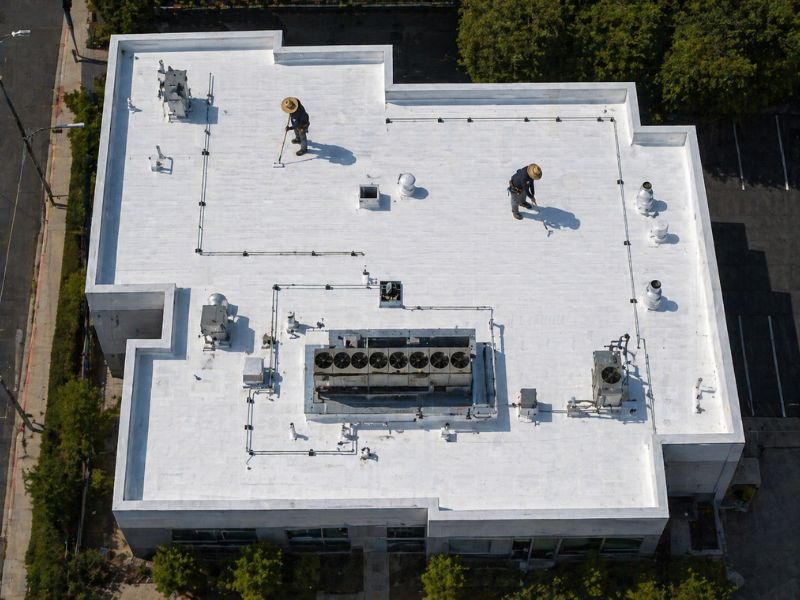
- Step 4 — Photo & Drone Documentation (as needed): Aerial overview via drone where airspace permits, supplementing ground-level documentation. We organize photos into a standardized grid keyed to inspection findings — every cited condition gets a corresponding annotated image. Overlay diagrams mark drainage patterns and condition zones. The result is a visual record of our roof evaluation process — reviewable by stakeholders who weren’t on site: facility managers, property owners, finance teams, insurance adjusters, board members.
Why it matters: A photo log isn’t documentation. An annotated map is. The report has to stand on its own when Method isn’t in the room.
- Step 5 — Condition Scoring: Every system component receives a numerical condition rating on a 1–10 scale: membrane, flashings, penetrations, drainage, deck, insulation, perimeter conditions. The roof system gets a composite score. The scoring methodology is repeatable. The same roof, evaluated by Method three years later, yields a comparable number — not a subjective “looks worse than last time.”
Why it matters: Condition scoring enables real lifecycle planning. “Your membrane scores 4 of 10 and is dropping roughly 0.5 per year — at 2 of 10 we recommend replacement” is a planning conversation. “Your roof is getting old” is not.
- Step 6 — Repair / Restoration / Replacement Analysis: Every evaluation presents three options, fully scoped and costed: repair (targeted intervention to address active issues), restoration (system-extending work such as silicone or acrylic coating), and replacement (full tear-off and new system installation). For each option, we model the 10-, 20-, and 30-year cost of ownership. We spell out manufacturer warranty implications. Method’s explicit recommendation follows, with the reasoning..
Why it matters: The most expensive option is not always the right option, and the cheapest option is not always a savings. A $30,000 silicone restoration that extends a roof’s life by 15 years often beats a $90,000 replacement on a 20-year cost basis. Most contractors don’t do this math because the math doesn’t favor their bid.
- Step 7 — Written Advisory Report (24–48 Hour Delivery): Within 24 to 48 hours of the inspection, you receive a written report — typically 8 to 16 pages — covering everything from steps 1 through 6. The report travels well: stakeholders, board members, finance teams, insurance carriers — anyone whose sign-off the decision requires. Method’s recommendation is in the report. The alternatives are also in the report. The reasoning behind the recommendation is in the report. Our role during roof evaluation process is to make the decision easier; your role is to make the decision.
Why it matters: A real artifact that survives the conversation. Most contractors give a verbal pitch and a single-page quote. Method’s roof evaluation process delivers a document that holds up to review.
Evaluation Report
What’s Actually in a Method Evaluation Report
Every report follows the same structure, regardless of property type or roof system. Consistency in our roof evaluation process is part of why the report is useful — facility managers reviewing reports across multiple properties get comparable information every time.
What to Expect From the Engagement
What the Roof Evaluation Process Looks Like From Your Side
Timeline.
From request submission to written report, expect 5 to 10 business days for standard evaluations. We typically schedule inspections within 3 to 5 business days of request. Our team delivers the written report within 24 to 48 hours of the inspection itself. For active leaks or urgent insurance timelines, we move faster — see our Report a Leak page.
On-site time.
Inspections typically take 1 to 4 hours depending on roof size and complexity. Residential evaluations are usually closer to 1–2 hours. Commercial and industrial evaluations on larger flat roofs can take a full half-day.
Access requirements.
Roof access is the biggest variable. We’ll coordinate with your facility team or property manager to arrange safe access. For occupied commercial properties, we work around tenant operations and notify in advance per your protocols.
Cost.
Evaluation pricing depends on property size and the scope of analysis required. Most evaluations fall within a defined range that we’ll confirm before the engagement begins — no surprise charges. For active commercial portfolios or recurring evaluation programs, we offer per-property and annual pricing structures.
How We Approach Roof Repair, Restoration, or Replacement
Evaluating Whether Your Roof Needs Repair, Restoration, or Replacement
Three categories of work. Each one is appropriate in different conditions. During the evaluation process we’ll determine which one is right for your roof — not the contractor’s revenue model.
Repair
Right when the roof system is fundamentally sound but has localized issues — failed seams, damaged flashings, isolated penetration leaks, ponding around a single drain. Repair makes sense when the underlying membrane still has service life left and the issues stay localized. Wrong call when the failure pattern spreads widely or substrate damage runs deep — at that point, repair throws money at a roof that needs more substantial work.
Restoration
Right for roof systems that are aging but structurally intact. Silicone, acrylic, or spray foam coating applied over a prepared existing membrane can extend service life by 10 to 20 years at roughly a third of replacement cost. Most appropriate for low-slope commercial and industrial roofs. Wrong call when the membrane has lost too much integrity or hidden moisture sits underneath — coating over a failing roof seals the failure in place.
Replacement
Right when the roof has reached end of service life, when restoration is no longer viable due to substrate or moisture conditions, or when the building’s use has changed in ways that demand a different system. Replacement resets the lifecycle clock, often with current-generation manufacturer warranties of 20 to 30 years. Wrong call when restoration would serve the same need at a fraction of the cost — which is more often than the industry typically admits.
Who Leads Method
The Experience Behind Method’s Roof Evaluation Process
Method’s evaluation methodology is built on more than a decade of Southern California roofing experience — and on a perspective most contractors don’t bring to the work: deep manufacturer-side system experience.
Jeff Moreno, Method’s principal and operations lead, has spent nearly a decade inside the roofing manufacturer channel. He held regional and territory roles at three major manufacturers — covering low-slope, steep-slope, and coatings systems across Southern California. Most recently, he served as Principal and COO of a Southern California roofing contractor, where he led operations across every category of roof system — low-slope and steep-slope, commercial and residential, repair and restoration and replacement.
That dual background — years of manufacturer-side training plus contractor-side operational leadership — is what makes Method’s evaluation methodology different. Most roofing contractors have install experience. Few bring the upstream system, spec, and warranty knowledge that comes from years inside the manufacturer channel — knowing not just how systems are installed, but how they’re designed, where they fail, and what the warranty terms actually cover.
Method is a founder-led Southern California roofing firm serving high-value residential, multifamily, commercial, industrial, and restoration projects. We hold manufacturer certifications across the systems we work with: Henry, CertainTeed, GAF, Everest Roofing Systems, Metacrylics, Carlisle, and Polyglass. Certified installation is required to access enhanced manufacturer warranty terms — terms non-certified contractors typically can’t offer — and reflects the specific training our team has completed across these systems.
Learn more about Method Roofing Group’s founder-led approach and Southern California roofing expertise on our About page.
Frequently Asked Questions About Roof Repair vs Roof Replacement
Roof Evaluation Process & Methodology
On-site inspections typically take 1 to 4 hours depending on roof size and complexity. Residential evaluations are usually 1 to 2 hours; commercial and industrial evaluations on larger flat roofs can take a full half-day. The written report is delivered within 24 to 48 hours of the inspection itself.
A standard inspection or quote produces a price for a single recommended repair. A Method evaluation produces a written advisory report presenting three costed options — repair, restoration, and replacement — with cost-of-ownership modeling and an explicit recommendation. The deliverable is a decision-support document, not a sales quote option.
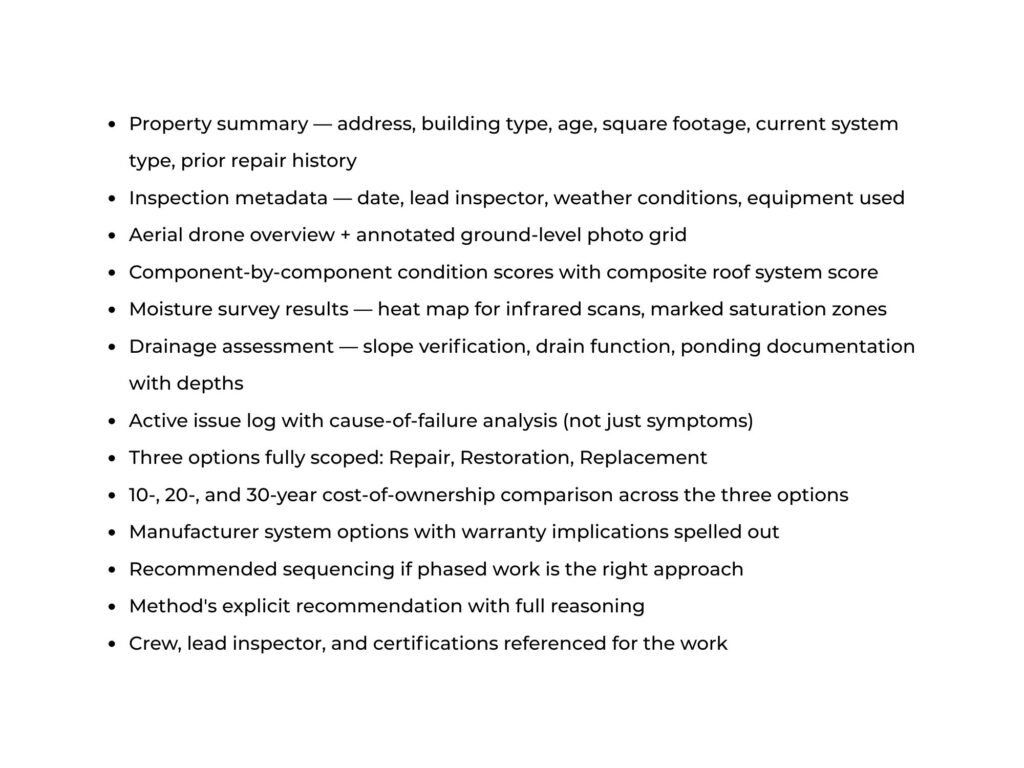
A typical report runs 8 to 16 pages and includes property summary, condition scoring per component, photo and drone documentation, moisture survey results (for flat roofs), drainage assessment, three fully-scoped options with 10/20/30-year cost-of-ownership comparison, and Method’s recommendation with reasoning. Designed to be shareable with stakeholders, finance, and insurance carriers.
For flat and low-slope roofs, we conduct an infrared moisture scan to identify hidden saturated insulation — moisture trapped beneath the membrane that hasn’t yet produced a visible leak. Roughly seven in ten premature flat-roof failures trace to hidden moisture, which is why this step is part of our standard methodology.
Standard evaluations are typically scheduled within 3 to 5 business days of request. For active leaks or urgent insurance timelines, see our Report a Leak page — emergency evaluations are scheduled faster, with response targeted within 24 hours where conditions permit.
Evaluation cost depends on property size, roof complexity, and scope of analysis required (for instance, whether infrared moisture scanning is included). Pricing is confirmed before the engagement begins — there are no surprise charges. For commercial portfolios or recurring evaluation programs, we offer per-property and annual pricing.
Upfront, almost always. Over time, not necessarily. A series of repairs on a roof that’s reached end of service life typically costs more than a single replacement when measured across a 10- to 20-year horizon. The cost-of-ownership analysis in the evaluation report is designed to make that comparison explicit.
That’s the most common outcome of a Method evaluation. We’re paid for the work we recommend — and we’re explicitly structured so the recommendation isn’t biased toward the most expensive option. If repair or restoration is the right call, that’s what the report will say, and that’s what we’ll quote.
Yes. Method operates under CSLB License #1157257 and carries general liability and workers’ compensation coverage. Documentation is available on request and is referenced in every evaluation report.
Method holds manufacturer certifications across the major commercial and residential systems we work with: Henry, CertainTeed, GAF, Everest Roofing Systems, Metacrylics, Carlisle, and Polyglass. Certified installation is required to access enhanced manufacturer warranty terms — which means the warranty options available through Method exceed what a non-certified contractor can offer.
Ready to See Your Roof, Honestly?
An evaluation gives you a clear repair, restoration, or replacement decision — backed by a written report, condition scoring, and cost-of-ownership analysis. No quote pressure. No surprise fees.
Schedule a roof inspection below — or call (949) 866-3011 to speak with our team directly and book by phone.
Request a Roof Inspection
