Commercial Roof Repair in Southern California
Fast, documented repairs for leaks, storm damage, seam failures, and flashing issues across every commercial roof system.
For commercial property owners facing active leaks, storm damage, or aging roof problems, Method Roofing Group delivers documented, code-compliant repairs across Southern California. Crews work on TPO, PVC, EPDM, modified bitumen, built-up roofing, and metal systems. Every repair is photographed, documented, and aligned with manufacturer warranty requirements so existing coverage stays intact.
What Is Commercial Roof Repair?
Commercial roof repair addresses localized failures on a commercial roof system — leaks, punctures, seam separations, flashing failures, drain issues, or storm damage — without replacing the entire roof. Repairs follow manufacturer specifications, work gets documented for property owner records, and existing warranties stay intact. As a result, property owners extend the useful life of their existing roof at a fraction of replacement cost.
Most commercial roof problems are repairable when caught early. Specifically, isolated leaks, punctures, seam failures, deteriorated flashings, and drain malfunctions all respond to targeted repair. However, widespread substrate damage, saturated insulation, or structural deck failure typically require restoration or replacement instead. Method’s inspection identifies which path is appropriate for each situation.
This page covers what commercial roof repair includes, the most common repair issues across Southern California, the roof systems Method repairs, the process from inspection to completion, and how to determine when repair is the right path versus restoration or replacement. For decision content comparing repair to replacement, see our Roof Repair vs Roof Replacement guide.
For active leaks that can’t wait, see our emergency roof leak repair page.
Common Commercial Roof Problems We Repair
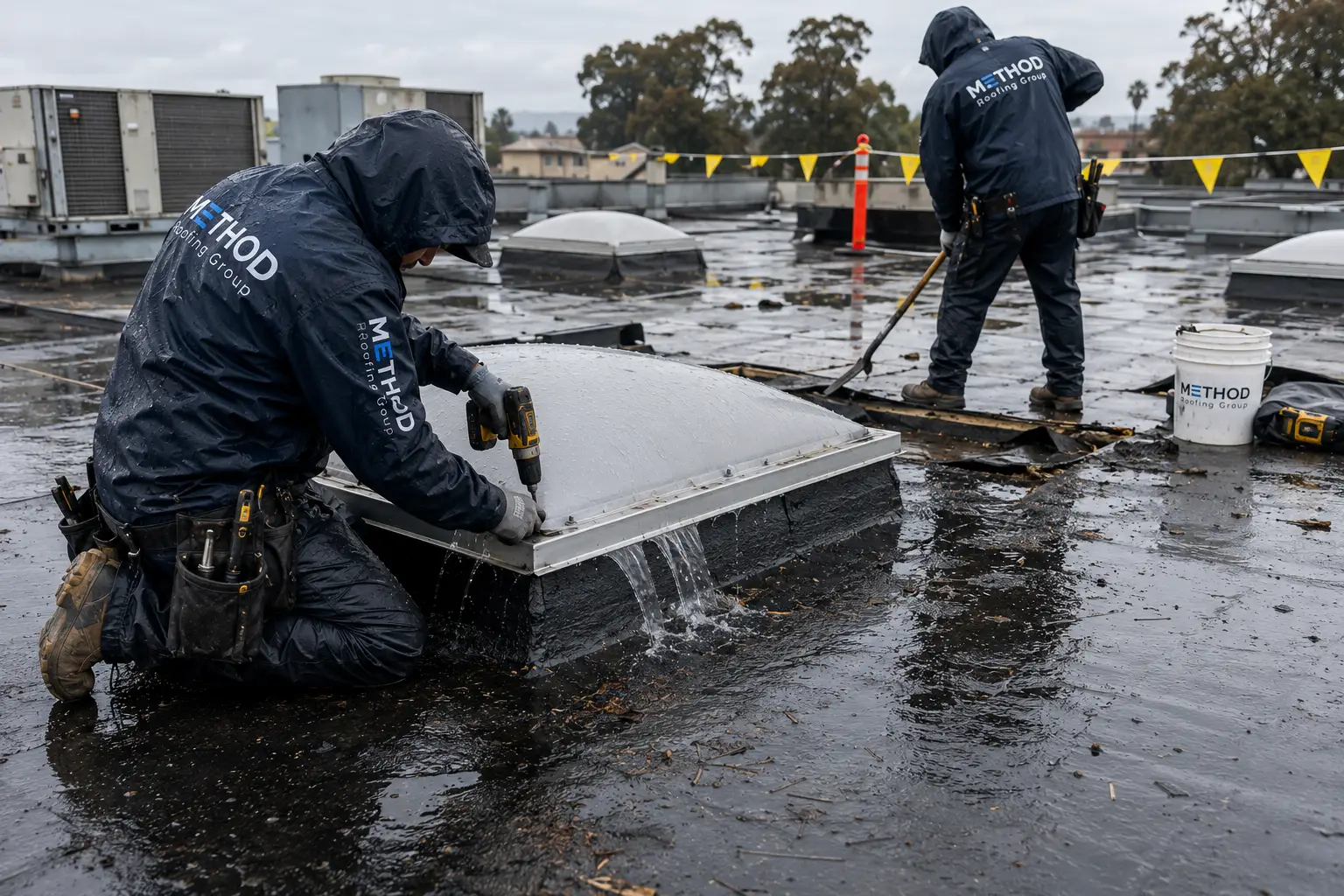
Commercial roofs in Southern California face specific failure patterns. Salt air, UV exposure, Santa Ana wind events, atmospheric river storms, and seismic activity all create predictable repair scenarios. Below are the issues Method addresses most frequently across the region.
Active Roof Leaks
Leaks announce themselves with ceiling stains, dripping during rain, or pooled water in the building interior. First, the team identifies the entry point — which is rarely directly above the visible damage. Then crews seal the actual source, repair underlying substrate damage if present, and document the repair for warranty records.
Active leak right now? Call 949.866.3011 — same-day response during business hours.
Punctures and Membrane Damage
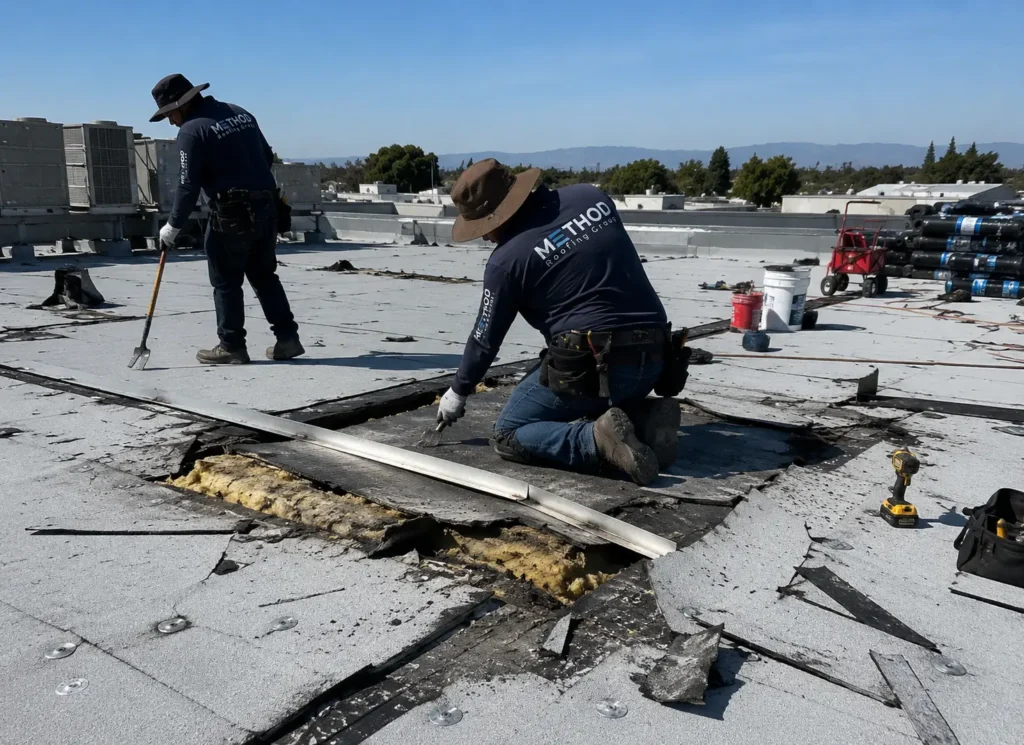
Foot traffic from HVAC service, satellite installations, or storm debris regularly punctures commercial membranes. Each puncture becomes a leak source. Specifically, crews patch punctures with manufacturer-approved repair material, reinforce the surrounding area, and inspect nearby high-traffic zones for additional damage.
Seam Separations and Failures
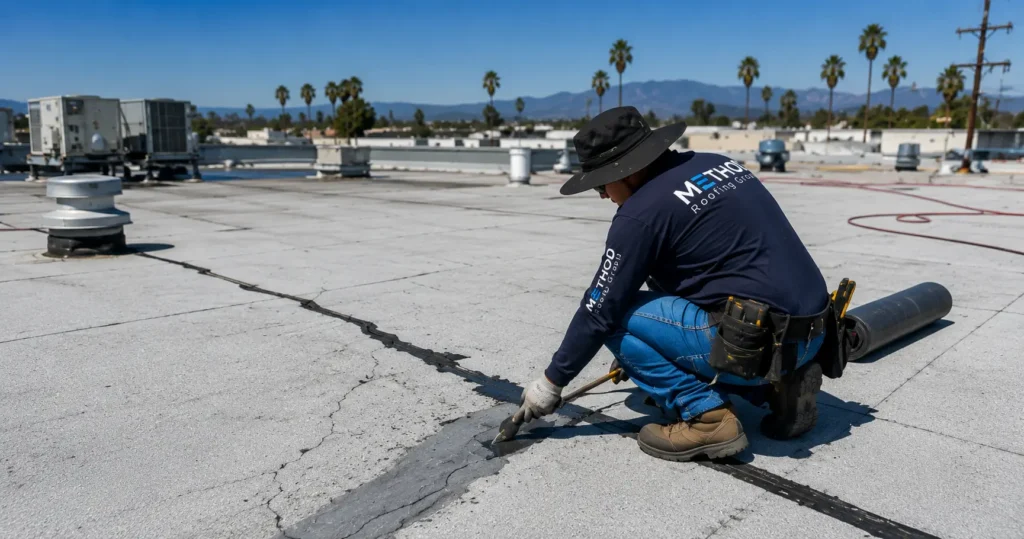
Seams are the most common failure point on single-ply commercial roofs. Heat-welded TPO and PVC seams can separate after years of UV exposure and thermal cycling. As a result, Method reseals failed seams using heat welding, primer-and-tape systems, or fluid-applied detail products depending on the substrate.
Flashing Failures
Flashings around penetrations, parapets, curbs, and equipment bases are the leak source on a significant percentage of repair calls. Inspection covers every penetration, failed flashings get replaced, and vulnerable areas receive reinforcement to prevent future failures.
Drain and Scupper Issues
Clogged, damaged, or undersized drains create ponding water — which then accelerates membrane failure. Crews clear drains, repair damaged scuppers, and address contributing factors like debris accumulation or sealant failure.
Storm and Wind Damage
Santa Ana wind events and atmospheric river storms cause membrane lift, flashing damage, debris impact, and drainage backups across Southern California commercial roofs. After major weather, Method provides post-storm inspection, emergency tarping where needed, and documented repair for insurance claim purposes.
Cracked or Failed Sealants
Roof sealants on metal roof fastener heads, pitch pans, and detail penetrations degrade under UV exposure. Cracked sealants leak quietly until interior damage appears. Replacement uses manufacturer-specified products during routine repair calls.
El Niño is heading to Southern California, get ahead of emergency roof leaks and prepare your commercial roof for El Niño 2026-27
Commercial Roof Systems Method Repairs
Different commercial roof systems require different repair approaches, materials, and tools. Method’s crews are trained across every major commercial roof system in service in Southern California. Below is what we repair and how each system’s requirements shape the work.
TPO Roof Repair
Thermoplastic polyolefin (TPO) repairs typically involve heat-welded patches, seam reinforcement, and membrane replacement on damaged areas. Crews use the manufacturer’s compatible patch material and document weld quality with peel testing where required for warranty compliance.
PVC Roof Repair
PVC repairs follow similar heat-welding principles as TPO but require PVC-specific compatible materials. Furthermore, aged PVC membranes lose flexibility, which affects repair technique selection. The team specifies the appropriate PVC repair product based on age and condition.
EPDM Roof Repair
EPDM (“rubber”) roofs use adhesive-based repair systems rather than heat welding. Patches require proper substrate cleaning and primer application. Method follows EPDM manufacturer specifications precisely — improper EPDM repair voids the warranty and accelerates failure at the patch perimeter.
Modified Bitumen and Built-Up Roofing (BUR) Repair
Modified bitumen repairs typically use compatible torch-applied or self-adhered patch material. BUR repairs may require asphalt-based products or compatible alternatives. Crew leads specify the correct repair system based on the existing roof configuration and warranty status.
Metal Roof Repair
Metal roof repairs focus on fastener replacement, seam sealant renewal, panel patch installation, and rust treatment. For older metal systems with widespread fastener failure, coating restoration often delivers better long-term value than repeated spot repair. See our commercial roof restoration options for aging metal substrates.
Foam (SPF) Roof Repair
Spray polyurethane foam roof repairs involve foam replacement, topcoat reapplication, and substrate inspection for moisture infiltration. Damaged areas get cut out, refilled with fresh foam, and recoated to restore the seamless waterproof surface.
When to Repair vs Restore vs Replace Your Commercial Roof
Repair is the right answer when the roof has localized problems and substantial remaining service life. However, repair stops being the right answer when failures become widespread, when the substrate is aging, or when repair costs accumulate beyond a reasonable threshold. The three scenarios below clarify the decision.
When Repair Is the Right Choice
Choose repair when the existing roof has isolated failures, the substrate is structurally sound, moisture intrusion is contained, and the roof has at least five years of useful life remaining. In these scenarios, targeted repair preserves existing warranty coverage and defers larger capital expense.
When Restoration Is the Better Path
When repairs become recurring, when surface deterioration is widespread, when reflectivity has dropped significantly, or when the substrate is sound but aging, commercial roof restoration typically delivers better long-term value than repeated repair. Restoration adds 10 to 20 years of service life through coating application, eliminating the recurring repair cycle.
When Replacement Becomes Necessary
Roofs with widespread substrate saturation, structural deck damage, failed insulation, or end-of-service-life structural condition require replacement. For typical commercial system service life expectations, see our reference on how long a commercial roof lasts.
Method’s inspection identifies which path applies to each specific roof. For deeper analysis comparing repair against replacement, see the Roof Repair vs Roof Replacement decision guide.
Method’s Commercial Roof Repair Process
Documented repair process protects warranty coverage, prevents recurring failures, and creates the records property owners need for capital planning and insurance claims. Method follows a consistent six-step process on every commercial repair project.
Step 1 — Inspection and Source Identification
First, the commercial team inspects the roof to identify the actual failure source — which is rarely directly above visible interior damage. Inspection includes visual assessment, moisture scanning where appropriate, seam evaluation, and substrate sampling on suspect areas.
Step 2 — Scope and Documentation
Next, a written repair scope gets developed — including failure description, repair method, materials specified, manufacturer compatibility verification, and pricing. Property owners receive the scope before any work begins.
Step 3 — Material Selection and Warranty Verification
Manufacturer-compatible repair materials get selected based on warranty compatibility. Specifically, using incompatible products on warrantied systems voids coverage — so this step matters.
Step 4 — On-Site Repair Execution
Crews complete the repair to manufacturer specification, including proper substrate preparation, material application, seam reinforcement, and finish detail. Throughout, weather conditions and cure windows follow product requirements precisely.
Step 5 — Photo Documentation
Every repair gets photographed before, during, and after completion. As a result, this documentation serves warranty records, insurance claims, capital improvement records, and future inspection reference.
Step 6 — Final Inspection and Owner Report
Finally, a final inspection verifies repair quality, confirms warranty status remains intact, and produces a written repair report delivered to the property owner. The report includes photos, materials used, scope completed, and recommended next-steps where applicable.
Inspection findings often identify localized failures that benefit from immediate attention. See our commercial roof repair pricing transparency and warranty maintenance protocols above — every repair stays aligned with the broader commercial roof restoration and maintenance strategy.
Emergency Commercial Roof Repair
Active commercial roof leaks during a storm, after a wind event, or following sudden damage require immediate response. Method provides same-day response for active leaks during business hours and emergency tarping for after-hours situations across Southern California.
Same-Day Leak Response
During business hours, Method dispatches the closest available crew to assess and address active commercial leaks. Initial response includes leak source identification, temporary containment, and either same-day permanent repair or scheduled follow-up depending on weather and scope.
Emergency Tarping
For active leaks during severe weather when permanent repair is not yet possible, Method provides emergency tarping to limit water intrusion and protect building interiors. Permanent repair then follows once weather permits.
Insurance Claim Documentation
Storm damage repair often involves insurance claim documentation. Method photographs storm damage thoroughly, provides written damage assessments, and coordinates with insurance adjusters when authorized by the property owner.
Active leak during business hours? Call 949.866.3011 for same-day response.
Why Property Owners Choose Method for Commercial Roof Repair
The wrong commercial roof repair voids warranty coverage, creates recurring failures, and wastes capital. The right repair extends roof life, protects existing warranties, and prevents future problems. Material selection, application technique, documentation, and manufacturer compatibility all matter.
Method Roofing Group is a commercially experienced roofing contractor headquartered in Newport Beach, California. The leadership team brings decades of combined commercial roofing experience across industrial, retail, multi-tenant, HOA, and institutional properties. Active project coverage extends across Orange County, Los Angeles, Riverside, San Bernardino, Ventura, and San Diego counties.
The Method team maintains current manufacturer certification training and continuing industry education. Active California Contractor’s State License Board (CSLB) credentials stay current. Every commercial repair project is documented, photographed, and overseen by a licensed Method team member from inspection through completion.
California Contractor’s License • CSLB Verified • Fully Insured • Manufacturer-Authorized Applicator
Commercial Roof Repair Service Areas
Method provides commercial roof repair across Southern California, with active project teams covering Orange County, Los Angeles, the Inland Empire, Ventura, and San Diego counties. For region-specific information, visit the relevant county service area page.
- Orange County Commercial Roofing →
- Los Angeles County Commercial Roofing
- Riverside County Commercial Roofing
- San Diego County Commercial Roofing
- San Bernardino County Commercial Roofing
- Ventura County Commercial Roofing
Common Questions About Commercial Roof Repair
How much does commercial roof repair cost?
Commercial roof repair costs vary based on failure type, roof system, materials required, square footage affected, and access conditions. Simple leak repairs typically start at a few hundred dollars. Larger storm damage or multi-area repairs scale accordingly. Method provides written estimates as part of the free repair inspection — no obligation to proceed.
Will my commercial roof warranty be voided by a repair?
Not when the repair uses manufacturer-compatible materials and follows specified procedures. However, incorrect materials, improper installation, or undocumented repairs can void warranty coverage. Therefore, Method verifies warranty compatibility before specifying any repair on warrantied systems and documents every repair for warranty records.
How fast can Method respond to an active commercial roof leak?
During business hours, Method dispatches the closest available crew for same-day response on active commercial leaks across Southern California. After-hours response is available for severe situations. For active leaks during business hours, call 949.866.3011.
Should I repair my commercial roof or replace it?
Repair is correct when failures are localized, the substrate is structurally sound, and significant remaining service life exists. Replacement becomes necessary when failures are widespread, the substrate is compromised, or repair costs reach a threshold that no longer justifies the work. For deeper analysis, see the Roof Repair vs Roof Replacement decision guide.
Does Method document repairs for insurance claims?
Yes. Method photographs every commercial repair before, during, and after work. Storm damage repairs include damage documentation appropriate for insurance claim filing. The team coordinates directly with insurance adjusters when authorized by the property owner.
What commercial roof systems does Method repair?
Method’s crews repair every major commercial roof system in service across Southern California — TPO, PVC, EPDM, modified bitumen, built-up roofing (BUR), metal, and spray polyurethane foam (SPF). Each system requires specific materials and techniques, and Method’s training covers all of them.
Request a Free Commercial Roof Repair Inspection
The first step is identifying the actual source of the problem — and confirming whether repair, restoration, or replacement is the right path. Method provides written commercial roof repair assessments at no cost, including source identification, repair scope, transparent pricing, and warranty compatibility verification. There is no obligation to proceed.
Schedule a roof inspection below — or call 949.866.3011 — same-day response for active leaks during business hours.
Request a Roof Inspection
