Commercial Roof Inspections in Southern California
Documented commercial roof inspections for capital planning, warranty maintenance, pre-purchase due diligence, and post-storm assessment.
For commercial property owners, asset managers, and facilities operators, Method Roofing Group provides documented commercial roof inspections across Southern California. Each inspection delivers a written report with photo documentation, condition assessment, repair recommendations, and remaining service life estimates. The result is the inspection record property managers need for capital planning, insurance, warranty maintenance, or pre-purchase decisions.
What Is a Commercial Roof Inspection?
A commercial roof inspection is a documented condition assessment of a commercial roof system, performed by a licensed roofing contractor to identify failures, predict remaining service life, and document the roof’s status for capital planning, warranty maintenance, insurance, or pre-purchase purposes. Each inspection produces a written report including photo documentation, condition findings, recommended repairs, and a service life estimate.
Multiple factors make commercial roof inspections important. Specifically, manufacturer warranties typically require documented inspections to maintain coverage. Insurance policies often require recent inspection records to process storm damage claims. Property managers need inspection documentation to plan multi-year capital expense. Furthermore, pre-purchase commercial property due diligence requires roof condition documentation to inform offer price and contingencies.
This page covers the types of commercial roof inspections Method performs, what’s included in each, the roof systems we inspect, when to schedule, and how the inspection process works from initial visit to final report. For a complete reference guide including inspection frequency standards and documentation templates, see our Commercial Roof Inspection Guide (coming soon).
Types of Commercial Roof Inspections Method Performs
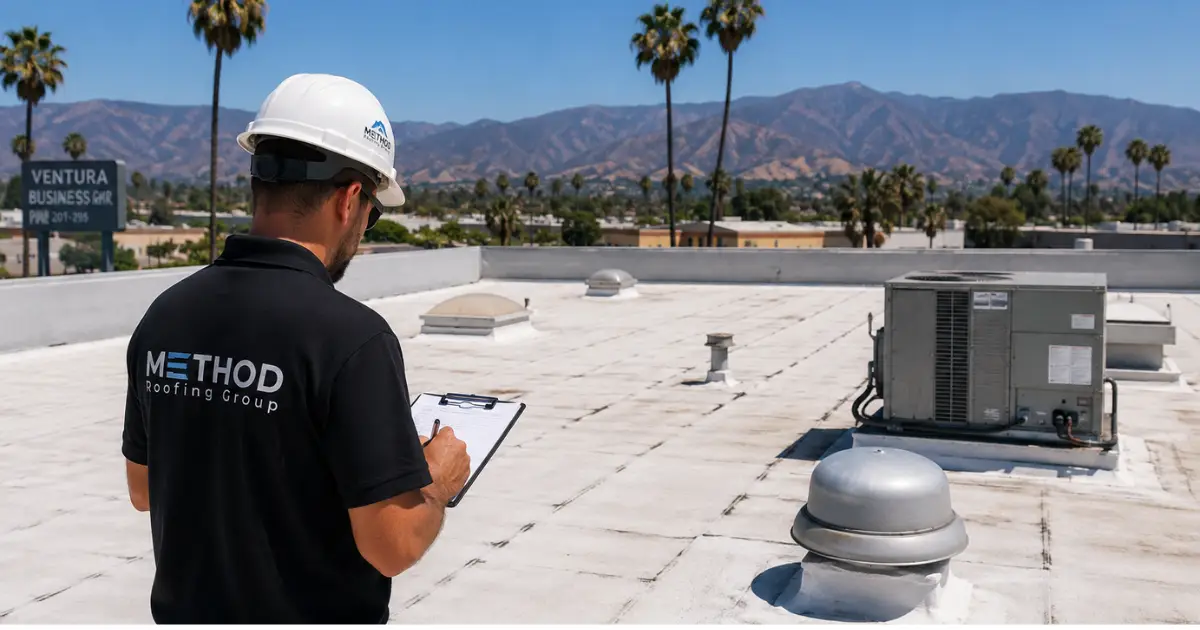
Different inspection purposes require different scope, methods, and documentation. Method performs every major commercial inspection type used in Southern California — from routine annual reviews to specialized infrared moisture surveys and pre-purchase due diligence assessments.
Annual and Semi-Annual Inspections
Most commercial roof warranties require documented inspections every 6 to 12 months to maintain coverage. Annual inspections also catch developing problems before they become expensive failures. Method’s annual inspection includes visual assessment, seam evaluation, flashing condition, drain function, and substrate sampling on suspect areas.
Post-Storm Inspections
After Santa Ana wind events, atmospheric river storms, or significant weather, post-storm inspections document damage for insurance claims and identify repairs before secondary damage develops. Method provides post-storm inspection within 48 to 72 hours of major weather events across Southern California.
Pre-Purchase Due Diligence Inspections
Commercial real estate transactions require documented roof condition assessment to inform offer price, contingencies, and post-close capital planning. Method’s pre-purchase inspection includes thorough substrate assessment, remaining service life estimate, repair cost projections, and replacement timeline projection appropriate for buyer due diligence.
Infrared and Thermal Imaging Inspections
Infrared moisture surveys identify wet insulation that visual inspection cannot detect. Specifically, thermal imaging cameras reveal moisture trapped beneath the membrane that retains heat after sunset, mapping wet areas across the entire roof. Method performs infrared inspections when moisture intrusion is suspected, when restoration eligibility needs verification, or when roof asset value depends on accurate substrate condition data.
Core Sample Inspections
For roofs with suspect substrate condition, infrared findings requiring confirmation, or pre-purchase situations requiring physical evidence, Method performs roof core samples. Core sampling cuts a small section through the roof assembly to physically verify substrate condition, insulation moisture content, and assembly construction.
Roof Asset Management Inspections
For property owners managing multi-property portfolios, Method provides standardized inspection protocols across multiple properties. Standardized inspections enable portfolio-level capital planning, prioritization across properties, and consistent documentation for asset management systems.
Schedule your pre-storm inspection + budget for 2026 replacement
What’s Included in a Method Commercial Roof Inspection
Every Method commercial roof inspection includes a consistent set of evaluation elements. The specific tools and depth vary by inspection type, but the foundation stays the same: visual assessment, condition documentation, written findings, and recommended action steps.
Visual Substrate Assessment
The inspection begins with comprehensive visual evaluation of the roof surface. Crews document membrane condition, surface degradation, seam integrity, fastener condition, and any visible damage. Photo documentation captures both overall roof condition and detail-level concerns.
Seam and Detail Evaluation
Seams are the most common failure point on single-ply commercial roofs. Method inspects every seam, evaluates seam integrity, and documents areas requiring repair. Detail evaluation includes flashings, penetrations, parapets, curbs, and equipment bases.
Drainage and Penetration Inspection
Drains, scuppers, and roof penetrations get individual evaluation. Clogged drains cause ponding water. Damaged scuppers create leak entry points. Sealant failures around penetrations are a leading source of leaks. Method documents the condition of each.
Moisture Detection (Where Appropriate)
For specific inspection types, Method performs infrared moisture scanning or moisture meter testing to identify saturated insulation or substrate. This step is typically included on pre-purchase, restoration eligibility, and infrared-specific inspections.
Written Inspection Report
Every Method inspection includes a written report delivered to the property owner. The report contains photo documentation, condition findings, immediate repair recommendations, longer-term repair or restoration projections, remaining service life estimate, and recommended next steps.
Capital Planning Recommendations
For property managers planning multi-year capital expense, Method’s inspection report includes repair priority categorization (immediate, short-term, medium-term, long-term), cost projection ranges, and recommended budget timing. This documentation supports portfolio-level capital planning.
Commercial Roof Systems Method Inspects
Each commercial roof system has specific failure patterns, inspection requirements, and warranty maintenance protocols. Our experienced team is trained on every major commercial roof system in service across Southern California — from single-ply membranes to built-up assemblies to metal.
TPO Roof Inspections
Thermoplastic polyolefin (TPO) inspections focus on membrane oxidation, seam integrity, surface chalking, and fastener condition. Inspection focuses closely on heat-welded seam integrity — failed welds are the most common TPO failure point.
PVC Roof Inspections
PVC inspections evaluate membrane flexibility, seam integrity, and surface condition. Aged PVC loses flexibility and becomes brittle, which creates failure risk. Method documents PVC condition with specific attention to age-related concerns.
EPDM Roof Inspections
EPDM (“rubber”) roof inspections focus on seam integrity, surface oxidation, and adhesive performance. EPDM seams typically fail through tape adhesive degradation rather than the membrane itself. Method inspects every seam and documents adhesive condition.
Modified Bitumen and Built-Up Roofing (BUR) Inspections
Modified bitumen and BUR inspections evaluate cap sheet condition, surface alligatoring, granule loss, and substrate condition beneath. Furthermore, embedded gravel ballast on BUR systems gets evaluation for displacement or deterioration.
Metal Roof Inspections
Metal roof inspections focus on fastener condition, seam sealant integrity, panel corrosion, and substrate evaluation. Specifically, fastener heads are the most common metal roof failure point — sealants degrade under UV exposure.
Foam (SPF) Roof Inspections
Spray polyurethane foam inspections evaluate topcoat condition, foam substrate moisture, and overall coating integrity. SPF requires specialized inspection protocols because topcoat failure exposes the foam to UV degradation.
When to Schedule a Commercial Roof Inspection
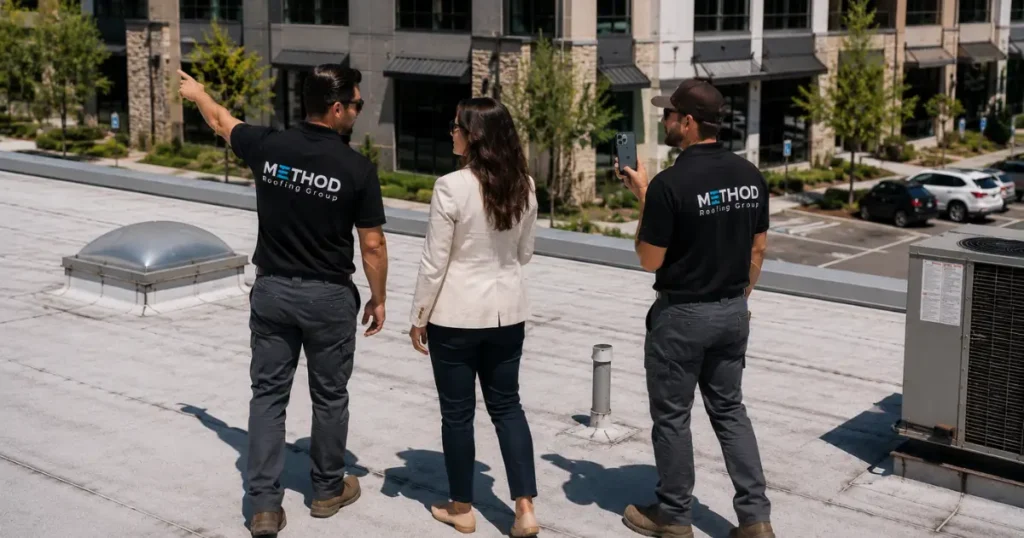
Timing matters. Annual inspections protect warranty coverage. Post-storm inspections capture damage before secondary problems develop. Pre-purchase inspections inform offer terms. The right inspection timing depends on the purpose.
Annual or Semi-Annual Scheduling
Most manufacturer warranties require documented inspection every 6 to 12 months. For properties under warranty, scheduling routine inspections protects coverage. Additionally, routine inspections catch developing problems while repair is still inexpensive.
After Major Weather Events
Post-storm inspection should happen within 48 to 72 hours after Santa Ana wind events, atmospheric river storms, hail, or significant weather. Quick post-storm assessment captures evidence needed for insurance claims and prevents secondary damage from undetected failures.
Before Commercial Property Purchase
For commercial real estate transactions, schedule pre-purchase inspection during the due diligence period. The inspection report informs offer price, contingencies, and post-close capital planning. Allow 5 to 10 business days for thorough pre-purchase inspection and report delivery.
When Restoration Eligibility Needs Verification
Before committing to commercial roof restoration, the substrate must qualify. Method’s inspection — often including infrared moisture survey — determines restoration eligibility. For aging roofs being considered for restoration, schedule inspection 30 to 60 days before project planning. See our commercial roof restoration service page for restoration scope and eligibility criteria.
At Roof System Service Life Milestones
At 10-year, 15-year, and 20-year service life milestones, schedule a detailed inspection to evaluate remaining service life and inform capital planning timing. For typical service life ranges by system type, see our reference on how long a commercial roof lasts.
When Visible Symptoms Appear
Active leaks, ceiling stains, ponding water, visible membrane damage, or any symptom suggesting problems triggers immediate inspection scheduling. Early detection is the most cost-effective roof asset management practice.
Method’s Commercial Roof Inspection Process
Method follows a documented inspection process designed for consistency, thoroughness, and useful documentation. Every commercial inspection follows the same six-step approach, with scope and tools adjusted to the inspection purpose.
Step 1 — Scope and Scheduling Discussion
First, the team discusses inspection purpose, scope requirements, access conditions, and scheduling with the property owner or manager. Specifically, pre-purchase inspections, post-storm inspections, and routine annual inspections each have different scope requirements.
Step 2 — On-Site Inspection
Next, the inspection team performs the on-site assessment. Visual evaluation covers the entire roof surface, seams, flashings, penetrations, drains, and substrate condition. Where appropriate, infrared scanning, moisture meter testing, or core sampling supplements visual inspection.
Step 3 — Photo Documentation
Throughout the inspection, the team documents conditions with comprehensive photo records. Overall roof condition, detail-level concerns, and specific failure points all get photographed for the inspection report.
Step 4 — Written Report Preparation
After on-site work, the inspection team prepares a written report including findings, photos, condition assessment, repair recommendations, service life estimates, and recommended next steps. Reports are typically delivered within 5 to 10 business days depending on inspection scope.
Step 5 — Report Review and Discussion
Report review happens with the property owner or manager. This discussion clarifies findings, explains repair priorities, and answers questions about recommended next steps. Furthermore, capital planning discussions identify the optimal timing for major work.
Step 6 — Action Step Implementation Support
Action steps follow — repair scheduling, restoration planning, or insurance coordination as needed, or providing additional documentation as needed.
Inspection findings often identify localized failures that benefit from immediate attention. See our commercial roof repair services for documented, warranty-compliant repair across every commercial roof system.
Why Property Owners Choose Method for Commercial Roof Inspections
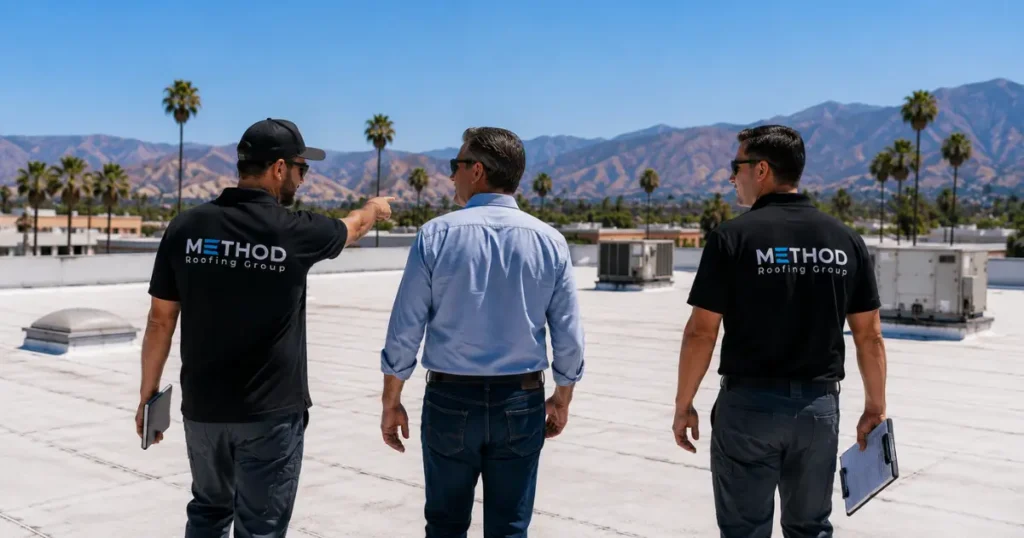
A commercial roof inspection is only as useful as the documentation it produces and the expertise behind the findings. Surface-level inspections that miss problems waste both inspection cost and the opportunity to address developing issues. Thorough inspections backed by experienced commercial roofing knowledge protect capital, preserve warranty coverage, and inform better asset management decisions.
Method Roofing Group is a commercially experienced roofing contractor headquartered in Newport Beach, California. The leadership team brings decades of combined commercial roofing experience across industrial, retail, multi-tenant, HOA, and institutional properties. Active project coverage extends across Orange County, Los Angeles, Riverside, San Bernardino, Ventura, and San Diego counties.
The Method team maintains current manufacturer certification training and continuing industry education. Active California Contractor’s State License Board (CSLB) credentials stay current. Every commercial inspection is performed and documented by a licensed Method team member with hands-on commercial roofing experience — not subcontracted to third-party inspection services.
California Contractor’s License • CSLB Verified • Fully Insured • Manufacturer-Authorized Applicator
Commercial Roof Inspection Service Areas
Across Southern California, Method delivers documented commercial roof inspections for capital planning, warranty maintenance, pre-purchase due diligence, and post-storm assessment.
- Orange County Commercial Roofing →
- Los Angeles County Commercial Roofing
- Riverside County Commercial Roofing
- San Diego County Commercial Roofing
- San Bernardino County Commercial Roofing
- Ventura County Commercial Roofing
At completion our team registers the completed project with the coating manufacturer to activate the full warranty. Property owners receive the manufacturer warranty certificate, installation photos, project documentation for capital records, and ongoing maintenance recommendations to preserve warranty coverage.
Common Questions About Commercial Roof Inspections
How much does a commercial roof inspection cost?
We provides free initial inspections for property owners considering repair, restoration, or replacement work. Detailed pre-purchase inspections, infrared moisture surveys, core sampling assessments, or comprehensive multi-property portfolio inspections may carry a fee depending on scope. Our policy to is to always discuss pricing transparently before any paid inspection begins.
How long does a commercial roof inspection take?
On-site inspection time varies by roof size, complexity, and scope. Specifically, a typical 10,000 to 50,000 square foot commercial roof takes 2 to 4 hours of on-site time for a thorough inspection. Larger properties or specialized scope (infrared, core sampling) take longer. Written report delivery typically follows within 5 to 10 business days.
How often should a commercial roof be inspected?
Most commercial roof manufacturer warranties require documented inspection every 6 to 12 months. Beyond warranty requirements, semi-annual inspection is recommended for properties over 10 years old, properties with prior repair history, or properties facing significant weather exposure. After major weather events, post-storm inspection is recommended within 48 to 72 hours.
Does an inspection void or affect my manufacturer warranty?
No. Manufacturer warranties typically require documented inspection to maintain coverage. Therefore, regular inspection protects warranty coverage rather than affecting it. Method documents every inspection in a format appropriate for warranty record keeping.
Can Method’s inspection be used for insurance claims?
Yes. Our comprehensive inspection documentation — including photos, written findings, and damage assessment — is appropriate for insurance claim filing. For active storm damage claims, Method coordinates directly with insurance adjusters when authorized by the property owner.
What’s the difference between a Method inspection and a third-party inspection?
Method’s inspections are performed and documented by licensed commercial roofing team members with hands-on installation, repair, and restoration experience. Third-party inspection services typically employ general inspectors without commercial roofing specialty expertise. The difference shows up in the depth of findings and the practical usefulness of repair recommendations.
Schedule a Commercial Roof Inspection
The first step is a conversation about inspection purpose, scope, and timing. Method provides commercial roof inspections across Southern California with documented written reports appropriate for capital planning, warranty maintenance, insurance, or pre-purchase due diligence. Initial inspections for repair, restoration, or replacement discussions are provided at no cost.
Schedule a roof inspection below — or call (949) 866-3011 to speak with our team directly and book by phone.
Request a Roof Inspection
